EMT Practice Test

1. Question Content...

Question List

Question1: A web client submits a request to http://localhost:8081/books/0471767840. The value "0471767840" is captured by a Set Variable transformer to a variable named booklSBN.
What is the DataWeave expression to access booklSBN later in the flow?

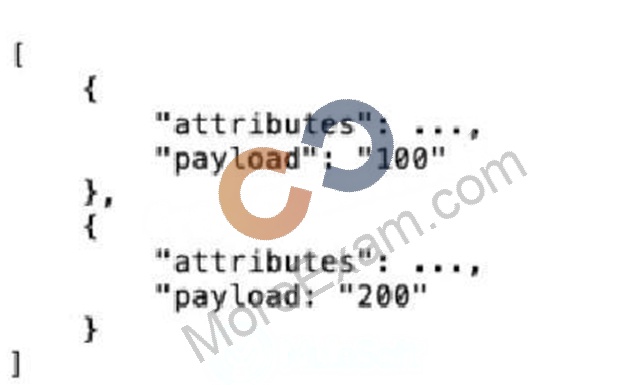
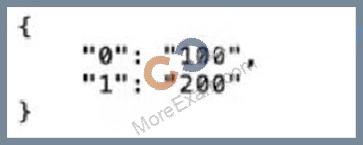
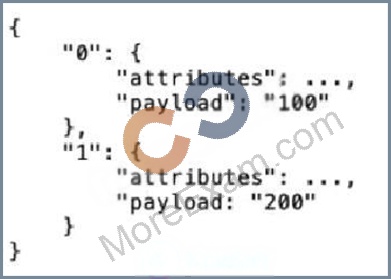
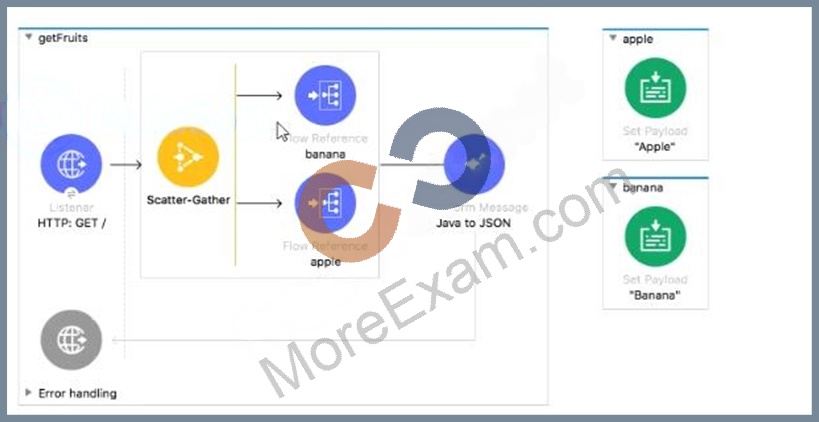
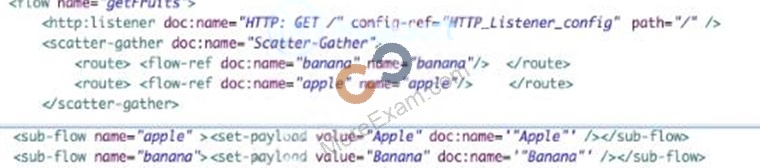
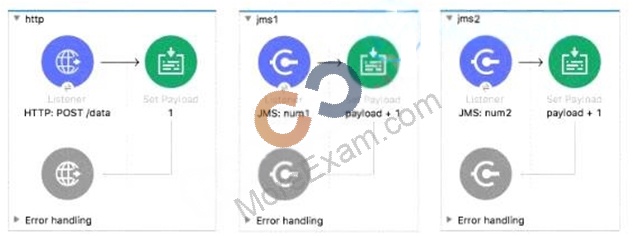
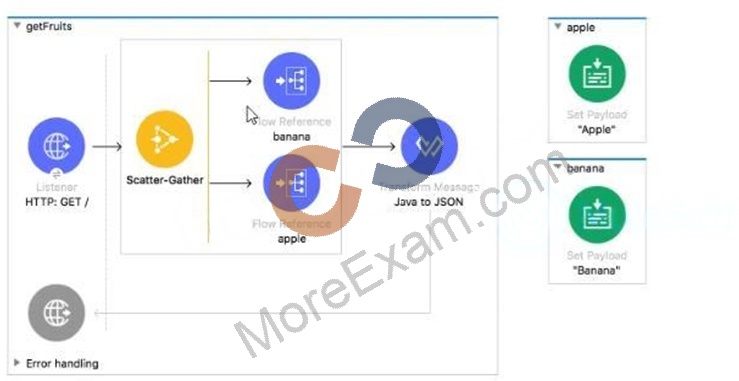
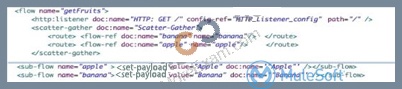
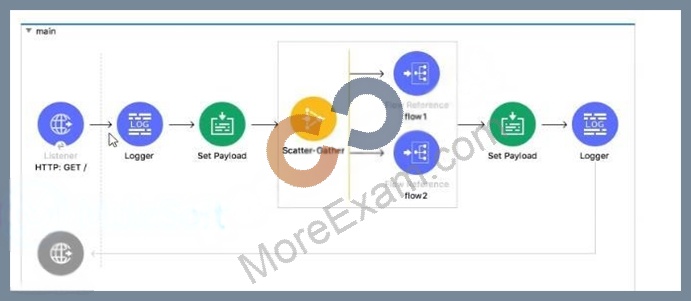
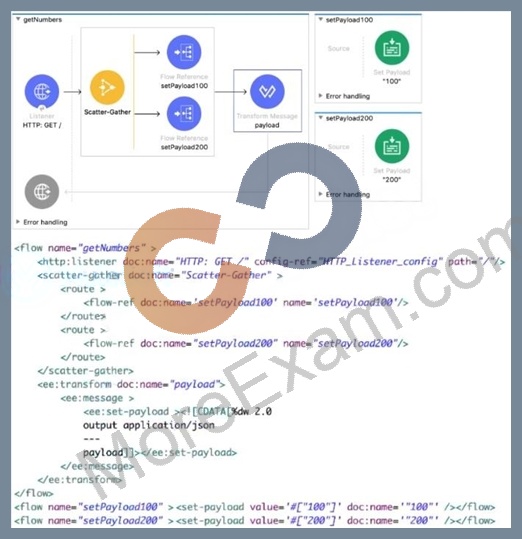
Question2: Refer to the exhibits.

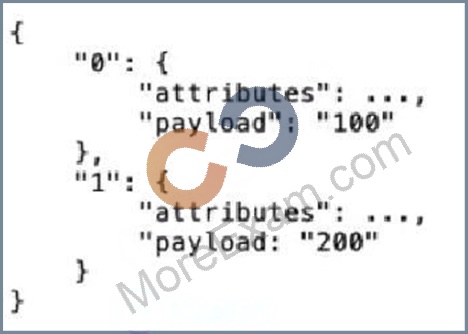
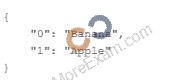
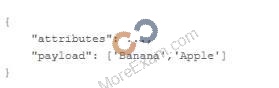
Each route in the Scatter-Gather sets the payload to the number shown in the label. What response is returned to a web client request to the HTTP Listener?
A)

B)

C)

D)

Question3: An API implementation has been deployed to CloudHub and now needs to be governed. IT will not allocate additional vCore for a new Mule application to act as an API proxy.
What is the next step to preseive the current vCore usage, but still allow the Mule application to be managed by API Manager?

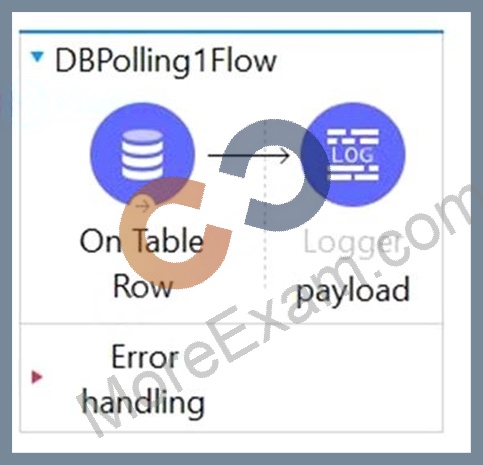
Question4: A Database On Table Row listener retrieves data from a CUSTOMER table that contains a primary key userjd column and an increasing kxjin_date_time column. Neither column allows duplicate values.
How should the listener be configured so it retrieves each row at most one time?

Question5: What is the purpose of the api:router element in APIkit?

Question6: What is the difference between a subflow and a sync flow?

Question7: What of the below is not a feature of API Notebooks?

Question8: Which of the below is used by Mule application to manage dependencies which make sharing the projects lightweight and easier?

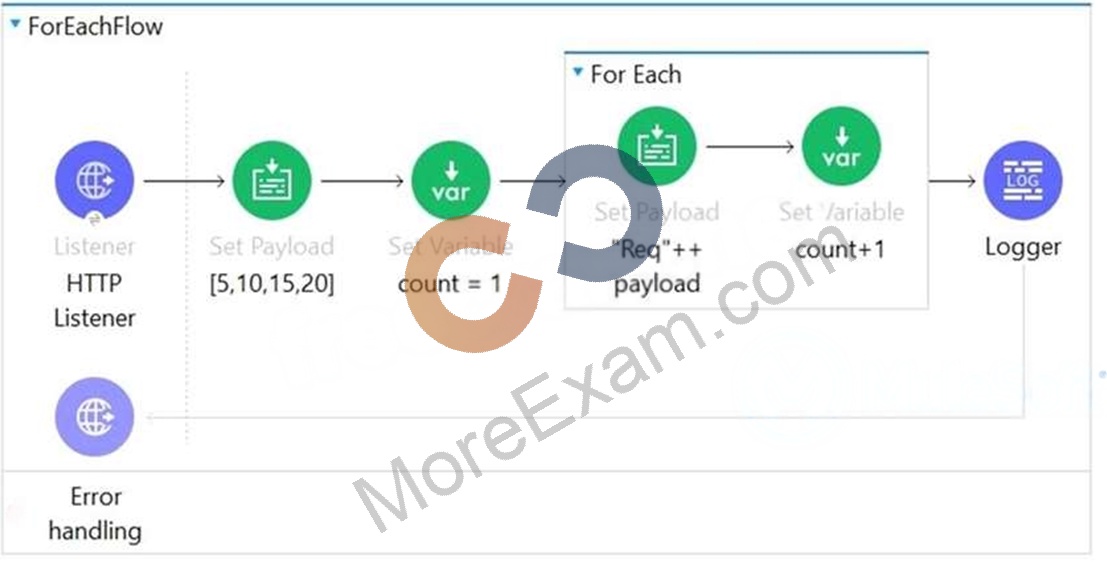
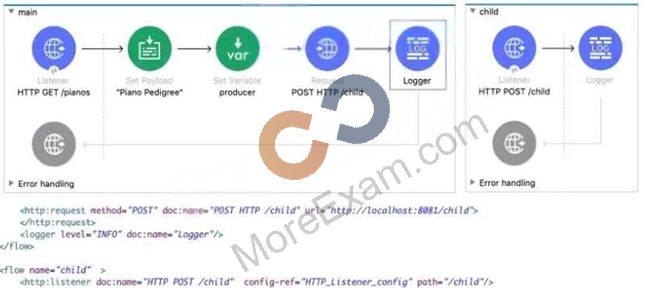
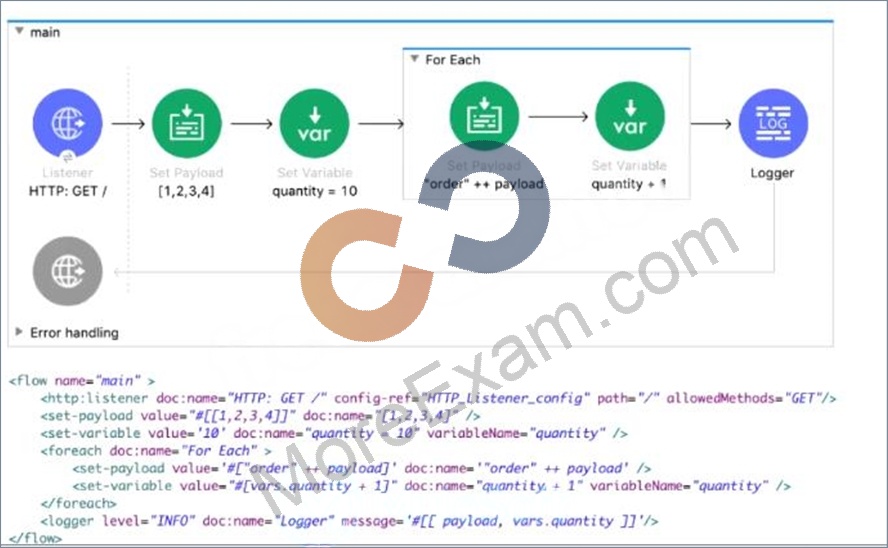
Question9: Refer to the exhibits.

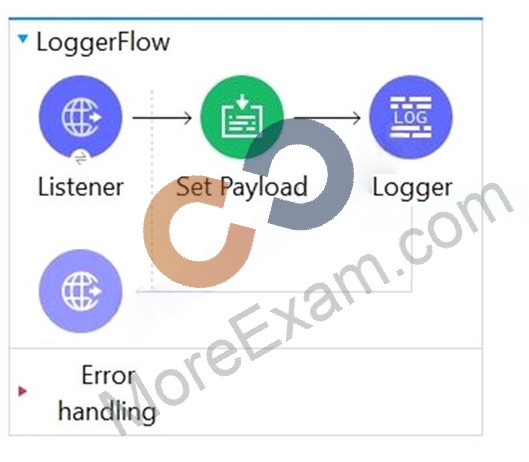
What payload and variable are logged at the end of the main flow?

Question10: Refer to the exhibit.

A Mule event is composed of a hierarchy of objects. Where in the hierarchy are variables stored?

Question11: To avoid hard-coding values, a flow uses some property placeholders and the corresponding values are stored in a configuration file.
Where does the configuration file's location need to be specified in the Mule application?

Question12: Refer to the exhibit.

What is the response to a web client request to
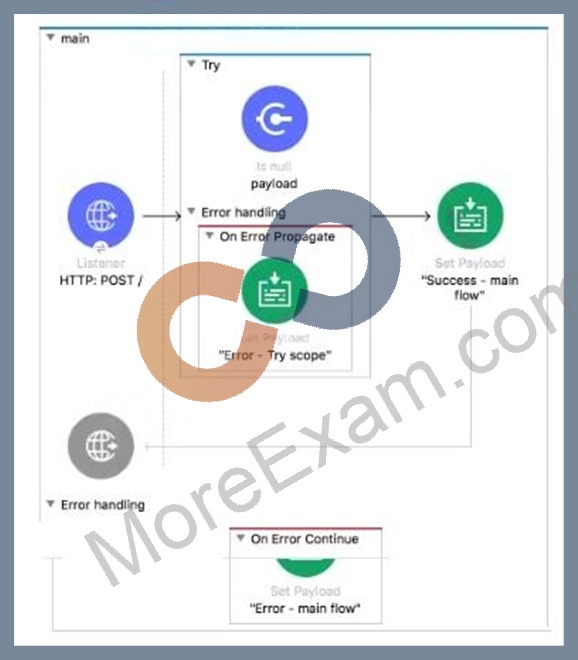
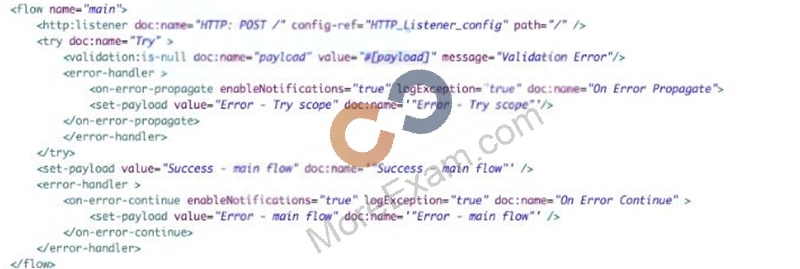
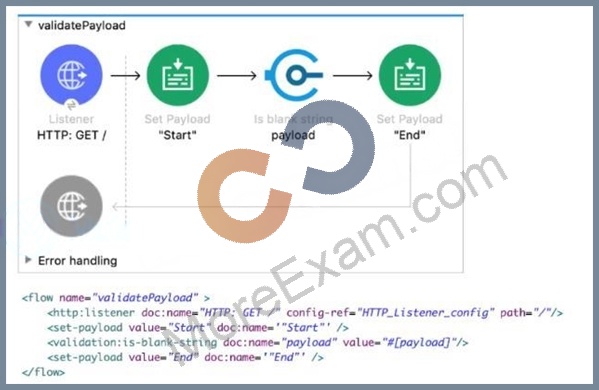
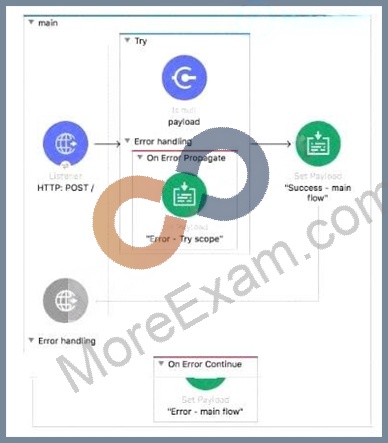
Question13: Refer to the exhibits.


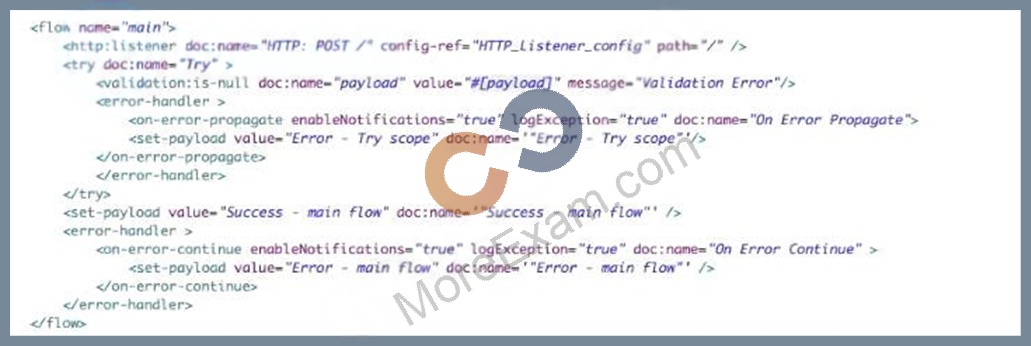
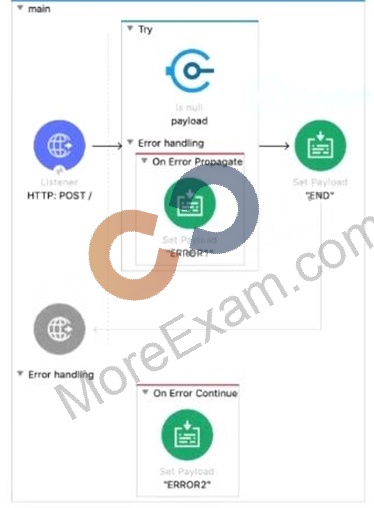
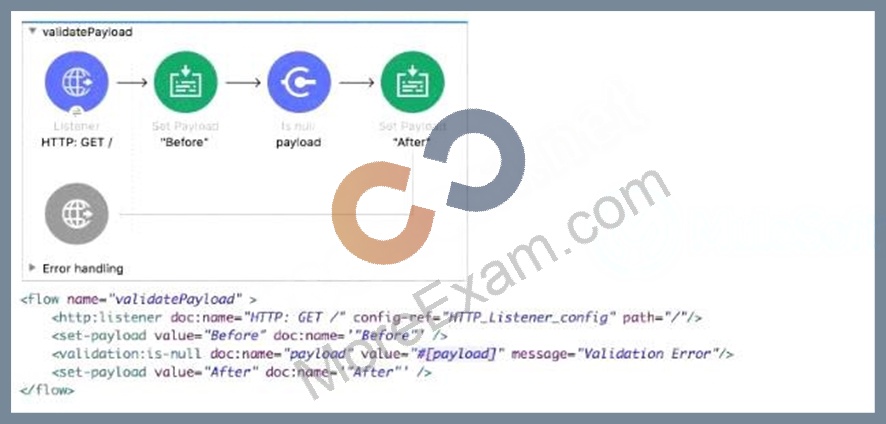
The Validation component in the Try scope throws an error.
What response message is returned to a client request to the main flow's HTTP Listener?
The Validation component in the Try scope throws an error. What response message is returned to a client request to the main flow's HTTP Listener?

Question14: Refer to the exhibit.

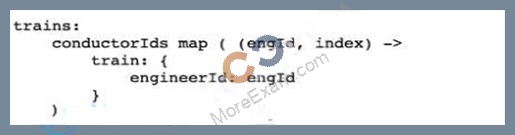
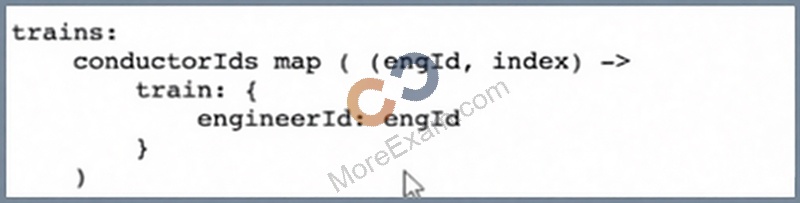
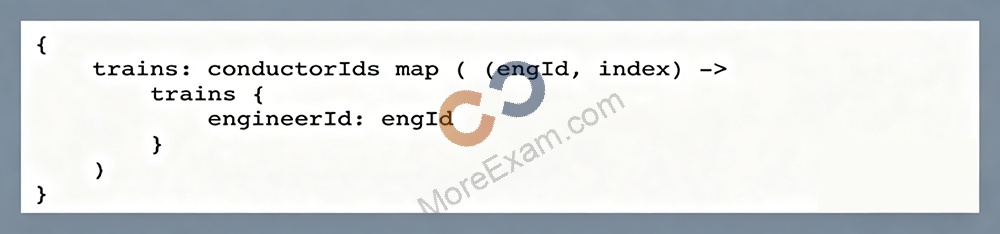
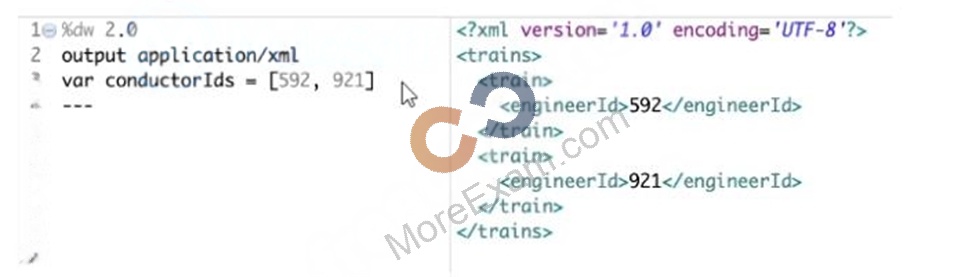
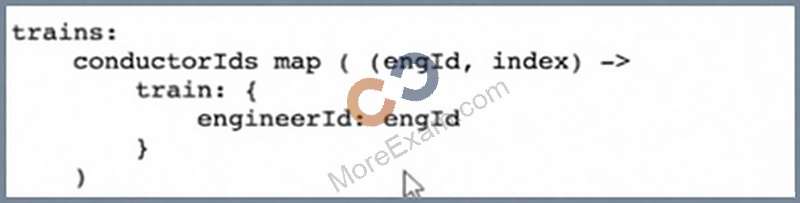
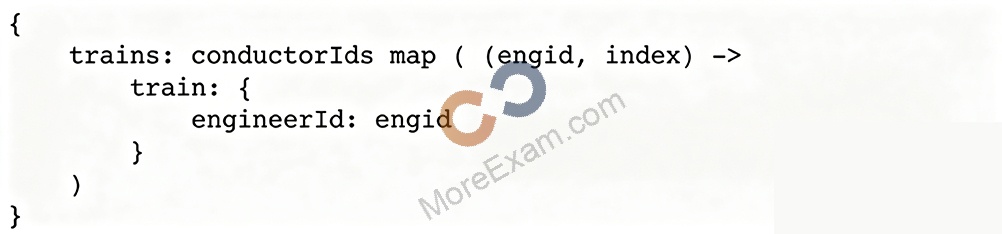
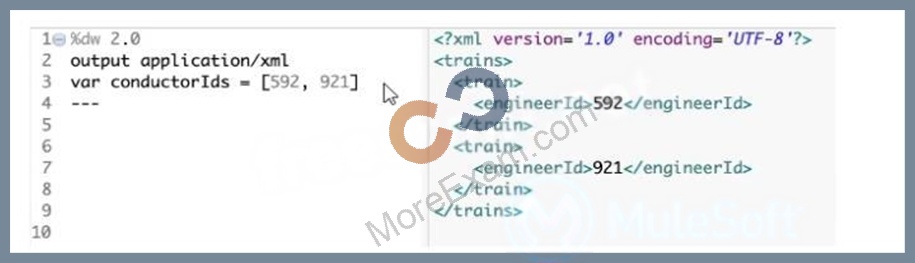
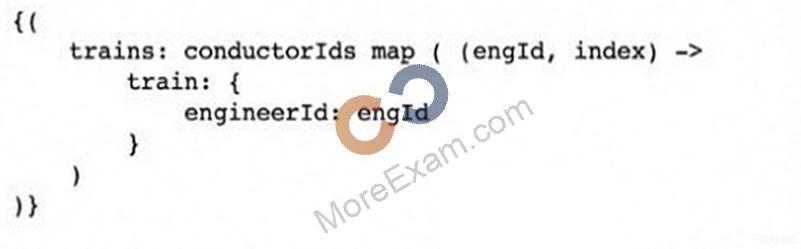
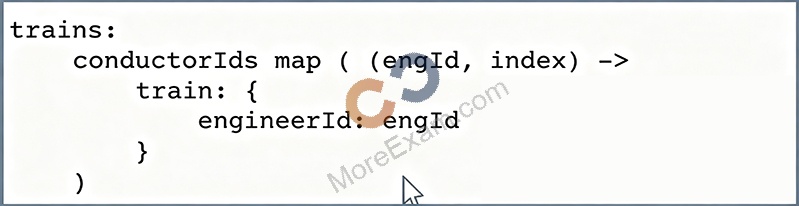
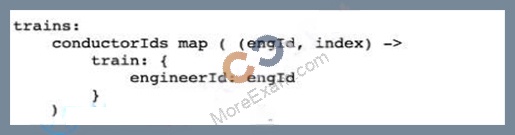
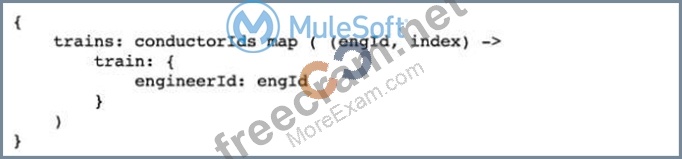
What DataWeave expression transforms the conductorlds array to the XML output?
A)

B)

C)

D)

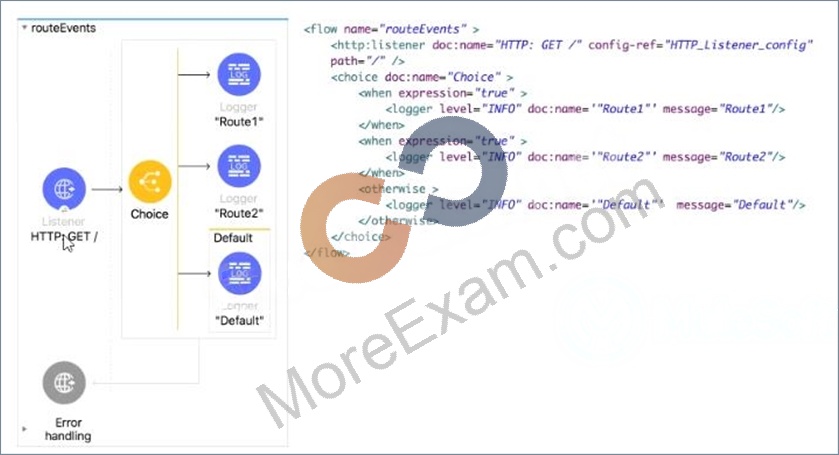
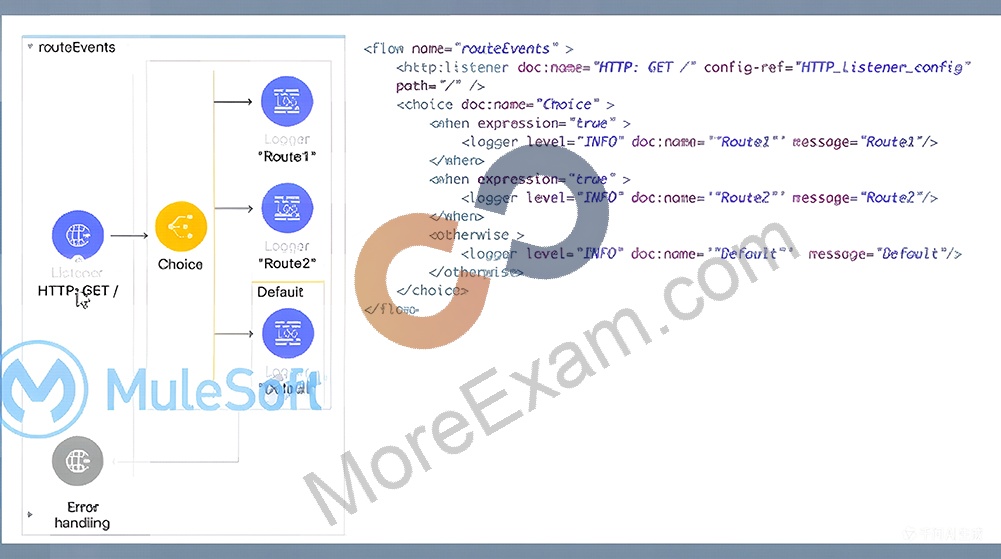
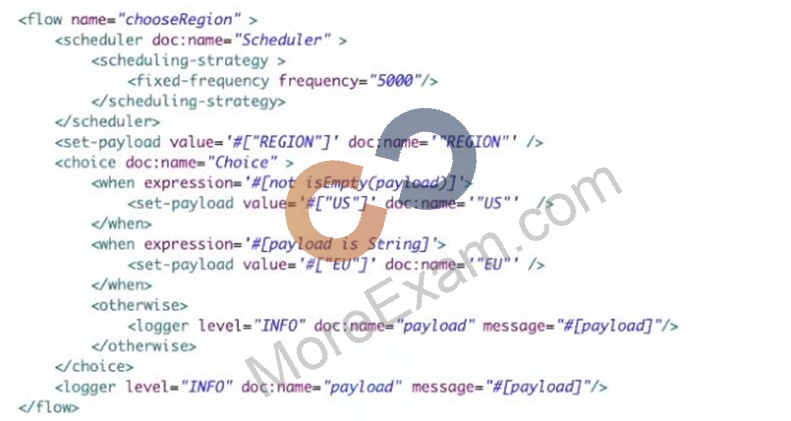
Question15: Refer to the exhibit.

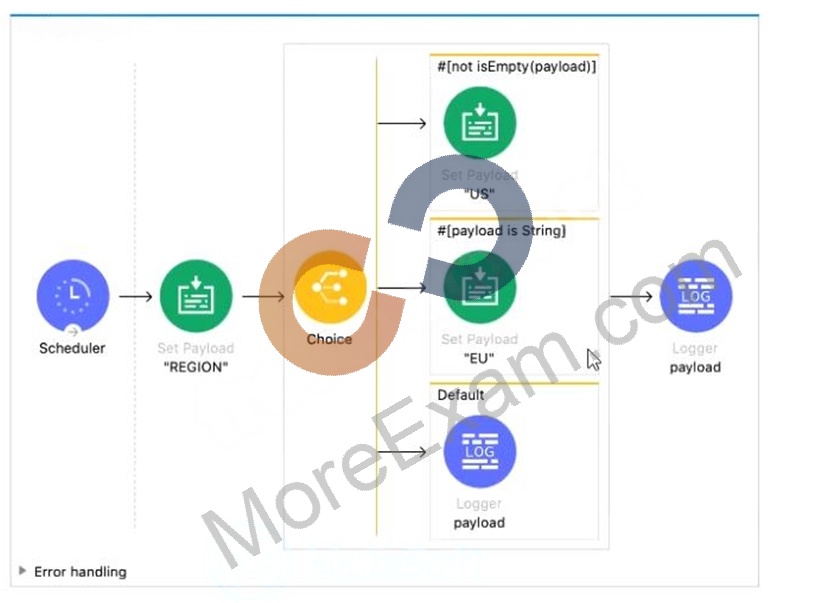
All three of the condition for the Choice router are true. What log messages are written?

Question16: Refer to the exhibits.

In the requestFlow an HTTP Request operation is configured to send an HTTP request with an XML payload. The request is sent to the HTTP Listener in the transform Flow.
That flow transforms the incoming payload into JSON format and returns the response to the HTTP request. The response of the request is stored in a target variable named the Result.
What is the payload at the Logger component after the HTTP Request?

Question17: What HTTP method in a RESTful web service is typically used to completely replace an existing resource?

Question18: An API implementation has been deployed to CloudHub and now needs to be governed. IT will not allocate additional vCore for a new Mule application to act as an API proxy.
What is the next step to preseive the current vCore usage, but still allow the Mule application to be managed by API Manager?

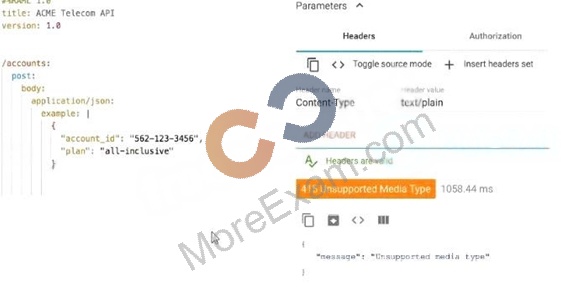
Question19: Refer to the exhibit.

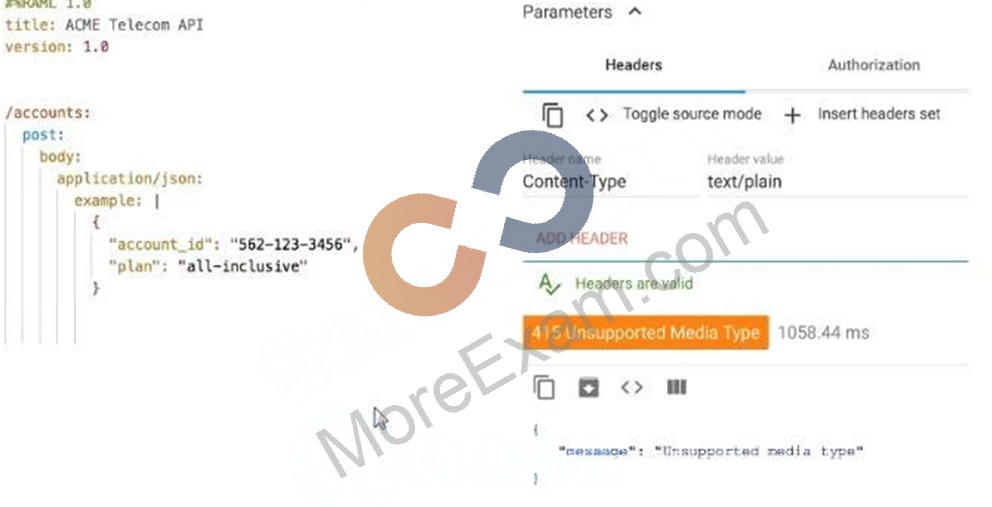
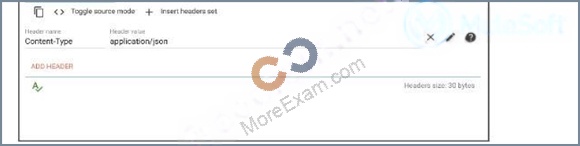
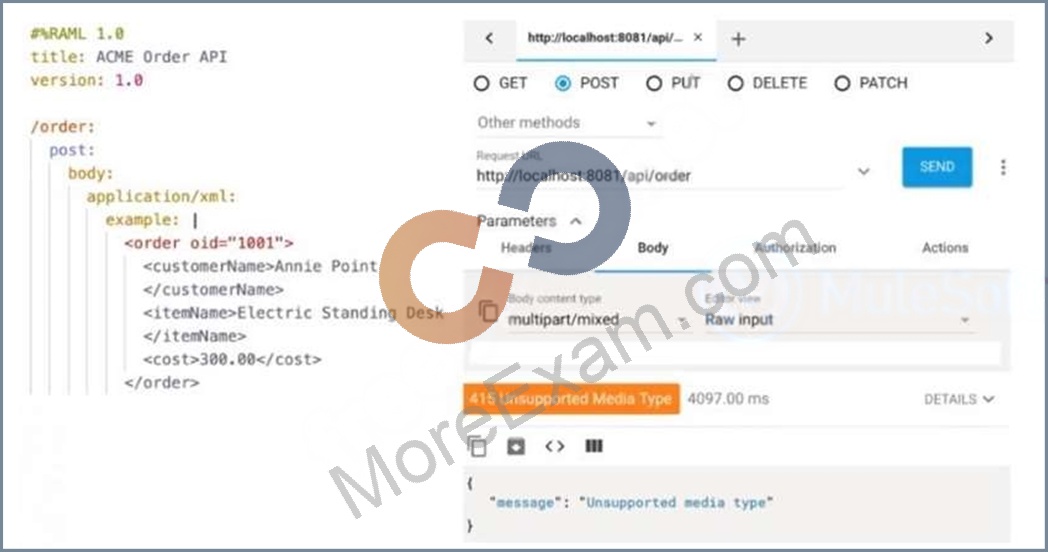
What should be changed to fix the 415 error?

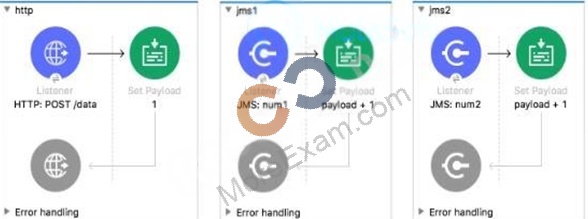
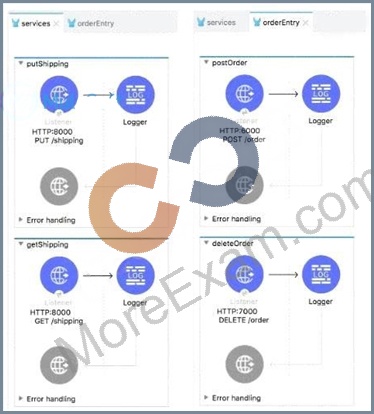
Question20: Refer to the exhibits.

The two Mule configuration files belong to the same Mule project. Each HTTP Listener is configured with the same host string and the port number, path, and operation values are shown in the display names.
What is the minimum number of global elements that must be defined to support all these HTTP Listeners?

Question21: Refer to the exhibits.


The Validation component in the Try scope throws an error.
What response message is returned to a client request to the main flow's HTTP Listener?
The Validation component in the Try scope throws an error. What response message is returned to a client request to the main flow's HTTP Listener?

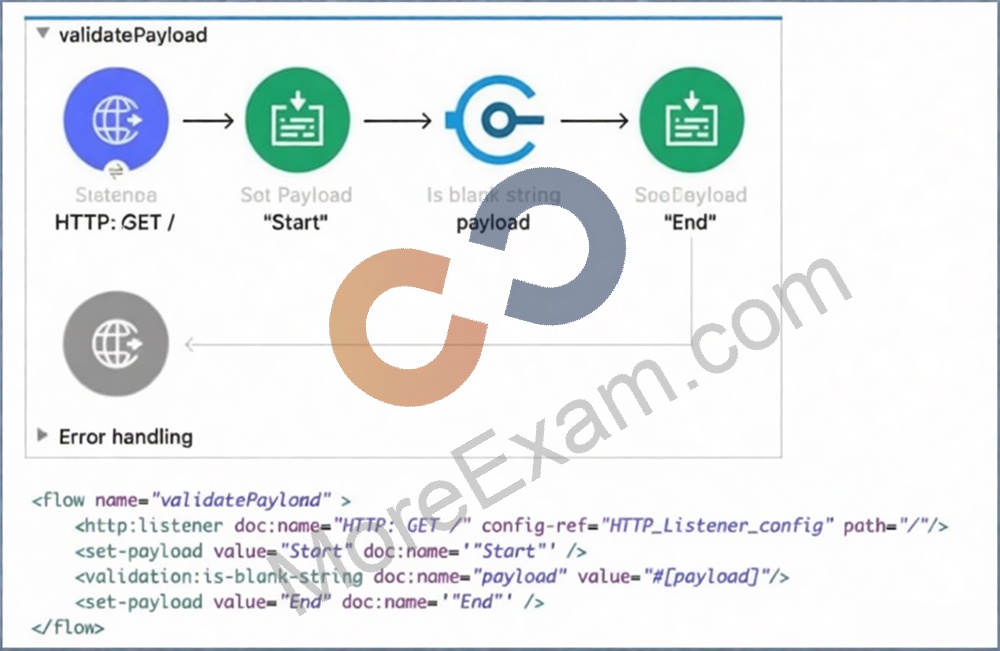
Question22: What module and operation will throw an error if a Mule events payload is not number ?

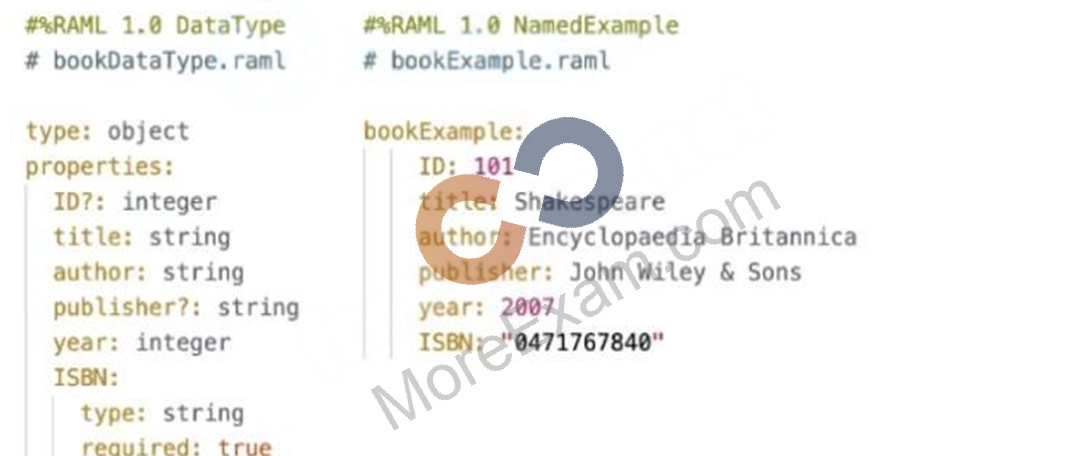
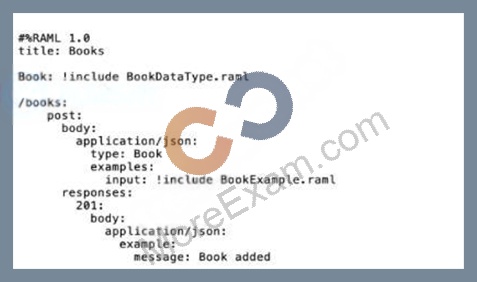
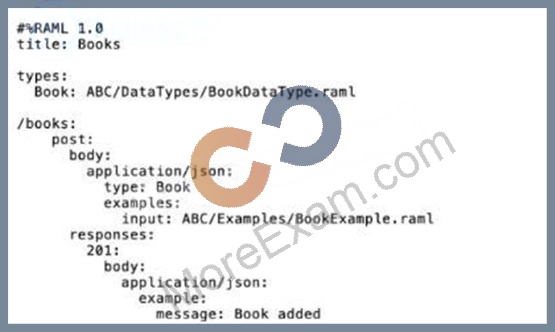
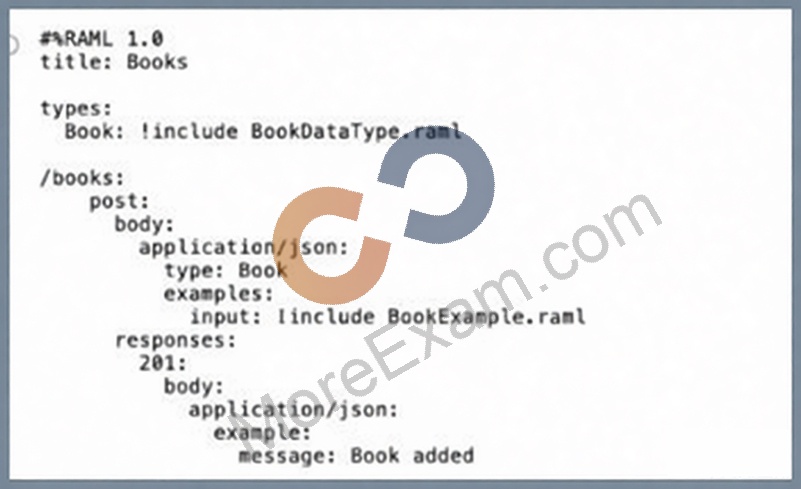
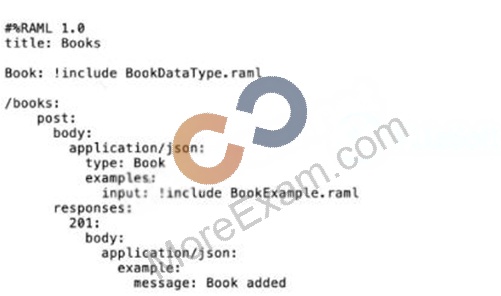
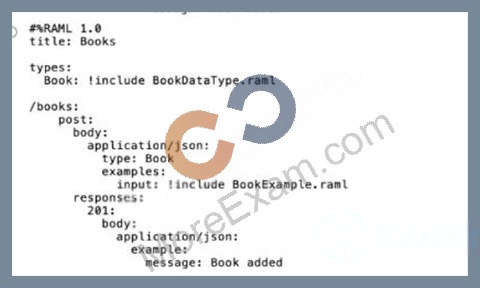
Question23: Refer to the exhibits. A company has defined this Book data type and Book example to be used in APIs. What is valid RAML for an API that uses this Book data type and Book example?

A)

B)

C)

D)

Question24: A RAML example fragment named StudentExample.raml is placed in the examples folder in an API specification project. What is the correct syntax to reference the fragment?

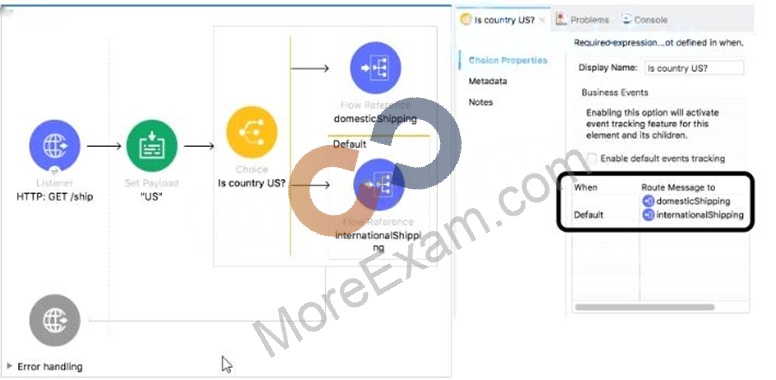
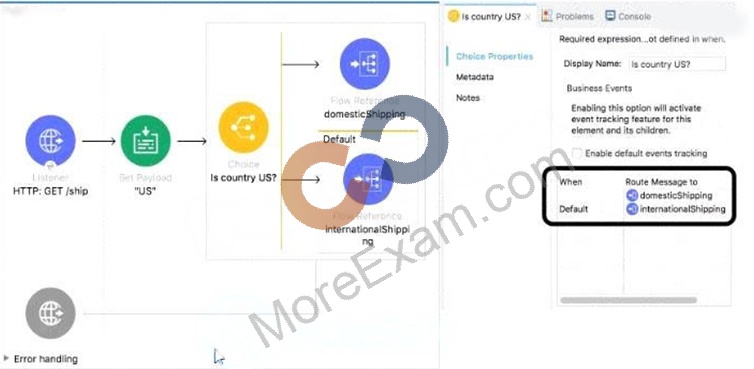
Question25: Refer to the exhibit.

What is a valid expression for the Choice router's when expression to route events to the documenticShipping flow?

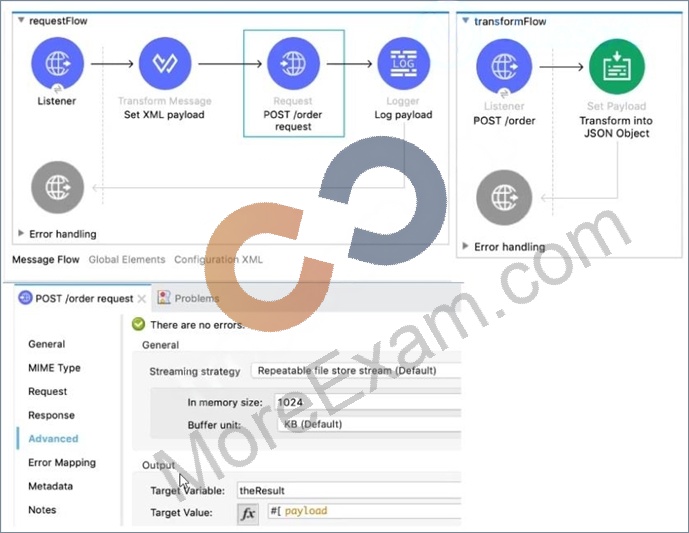
Question26: Refer to the exhibits.

In the requestFlow an HTTP Request operation is configured to send an HTTP request with an XML payload.
The request is sent to the HTTP Listener in the transform Flow.
That flow transforms the incoming payload into JSON format and returns the response to the HTTP request.
The response of the request is stored in a target variable named the Result.
What is the payload at the Logger component after the HTTP Request?

Question27: What is not true about application properties?

Question28: A Mule project contains a DataWeave module like WebStore.dwl that defines a function named loginUser. The module file is located in the project's src/main/resources/libs/etl folder.
What is correct DataWeave code to import all of the WebStore.dwl file's functions and then call the loginUser function for the login
"
[email protected]"?

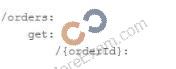
Question29: What valid RAML retrieves details on a specific by its orderld as a URL parameter?
A)

B)

C)

D)

Question30: Refer to the exhibits.


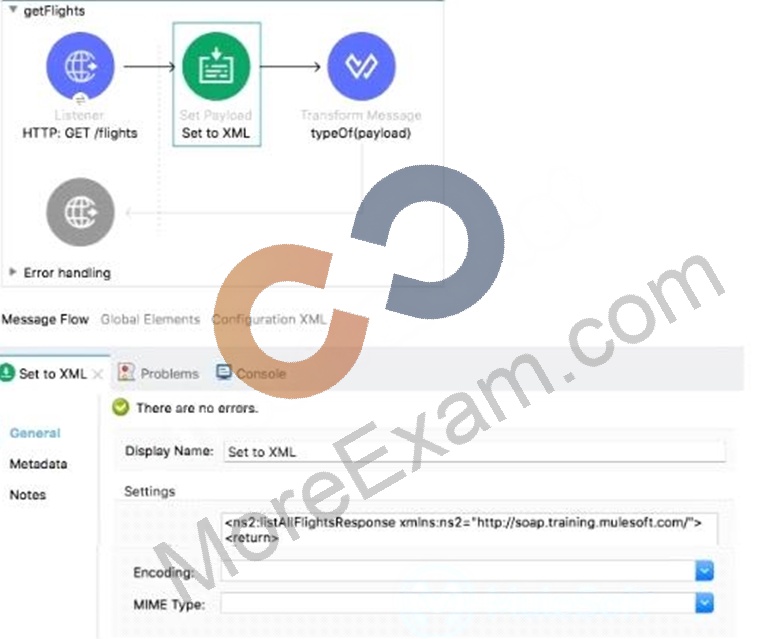
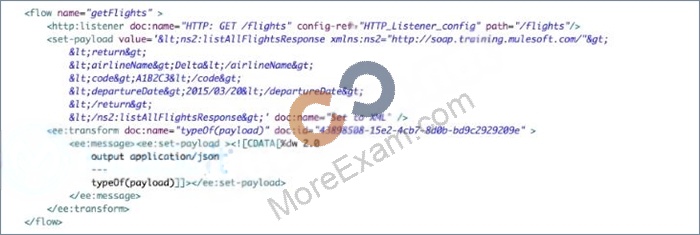
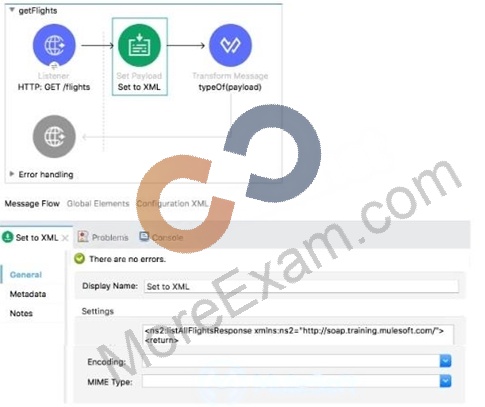
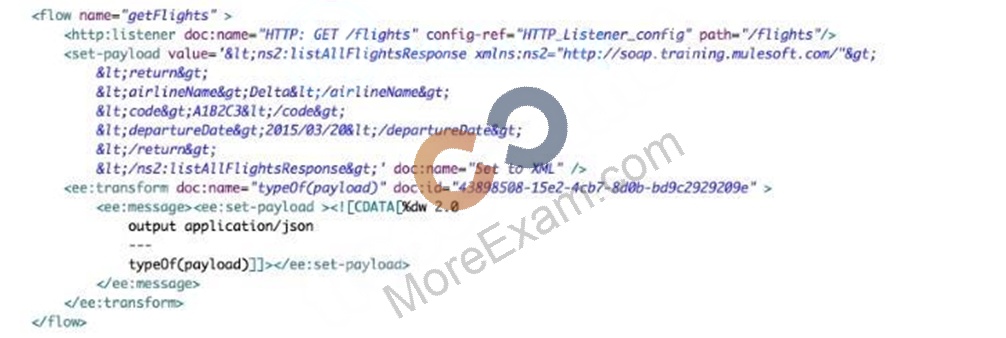
A web client submits a request to http://localhQst:8081 /flights. What is the result at the end of the flow?

Question31: A Mule application's HTTP Listener is configured with the HTTP protocol. The HTTP listeners port attribute is configured with a property placeholder named http.port. The mule application sets the http.port property placeholder's value to 9090 The Mule application is deployed to CloudHub without setting any properties in the Runtime manager Properties tab and a log message reports the status of the HTTP listener after the Mule application deployment completes.
After the mule applications is deployed, what information is reported in the worker logs related to the port on which the Mule application's HTTP Listener listens?

Question32: Refer to the exhibit.

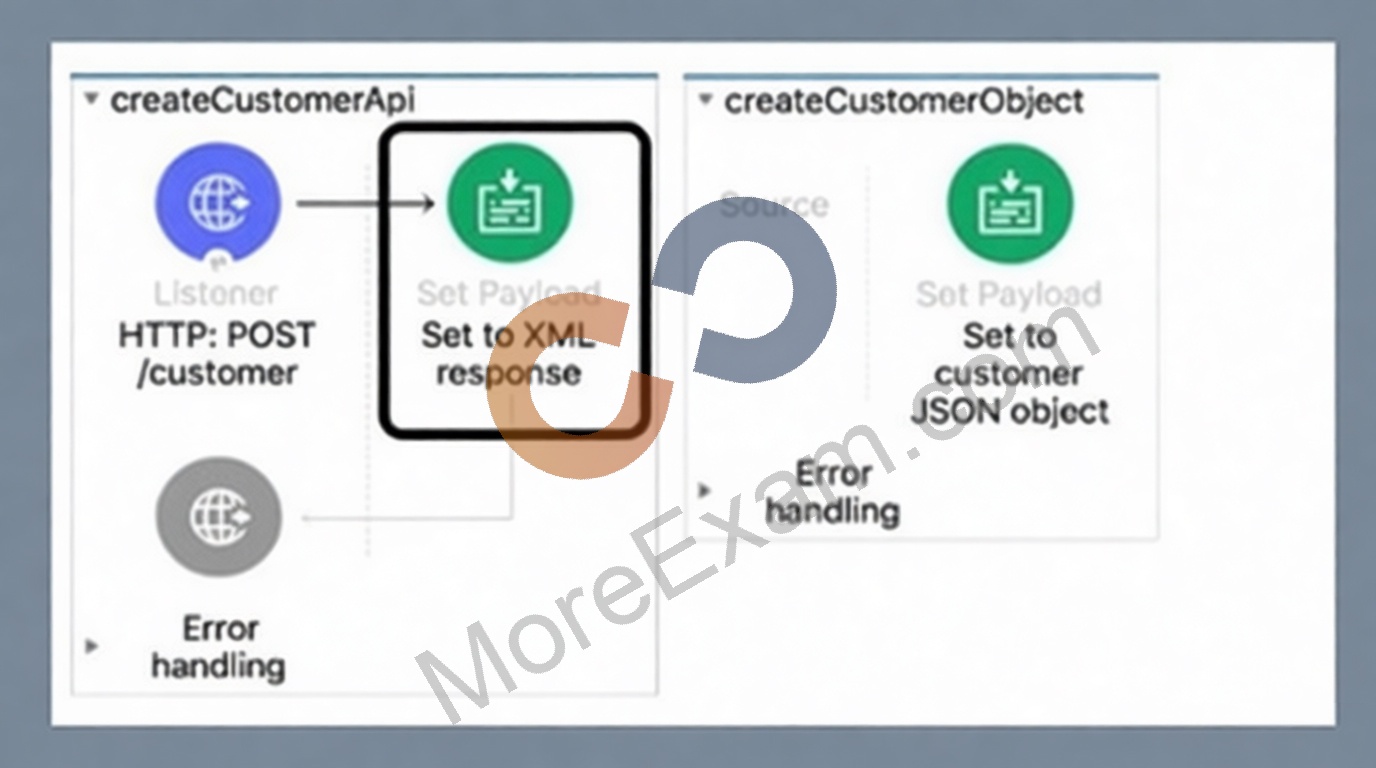
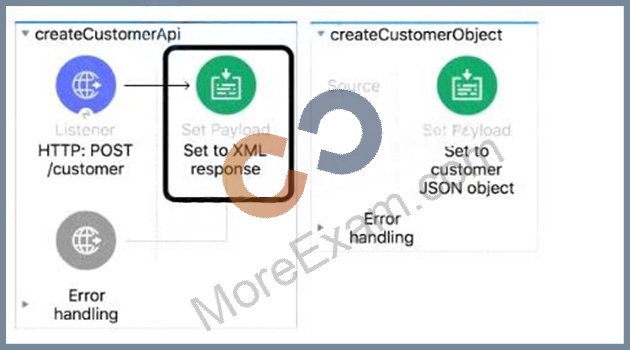
What is the correct DataWeave expression for the Set Payload transformer to call the createCustomerObject flow with values for the first and last names of a new customer?

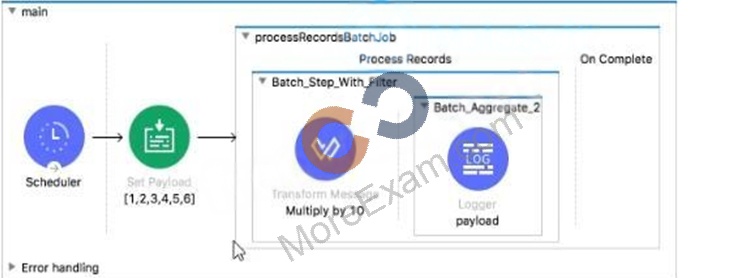
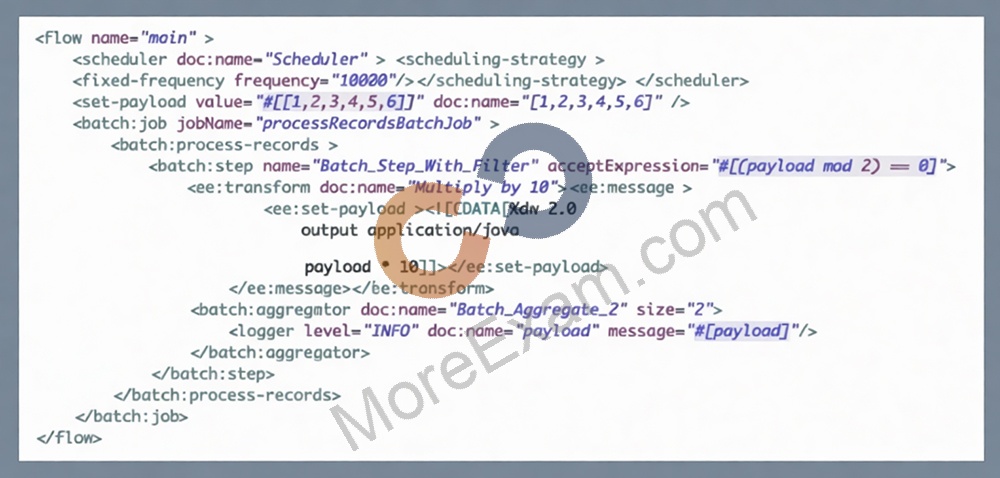
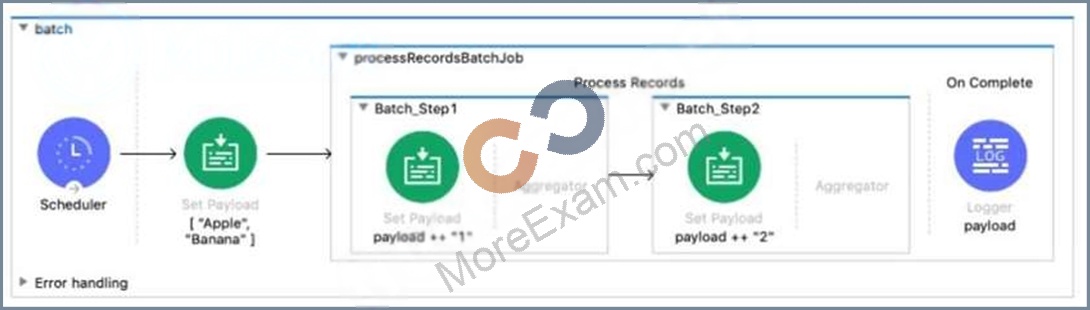
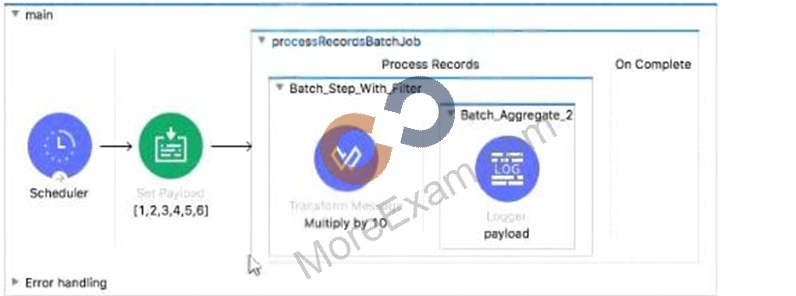
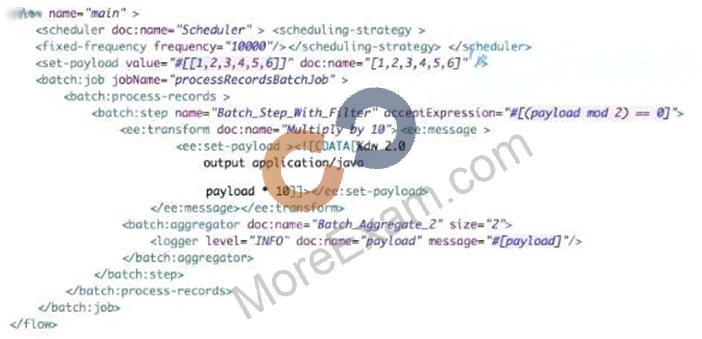
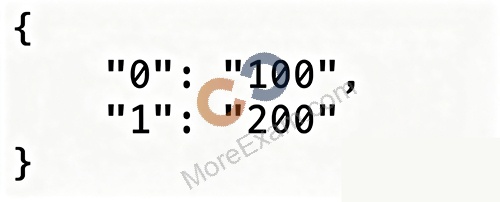
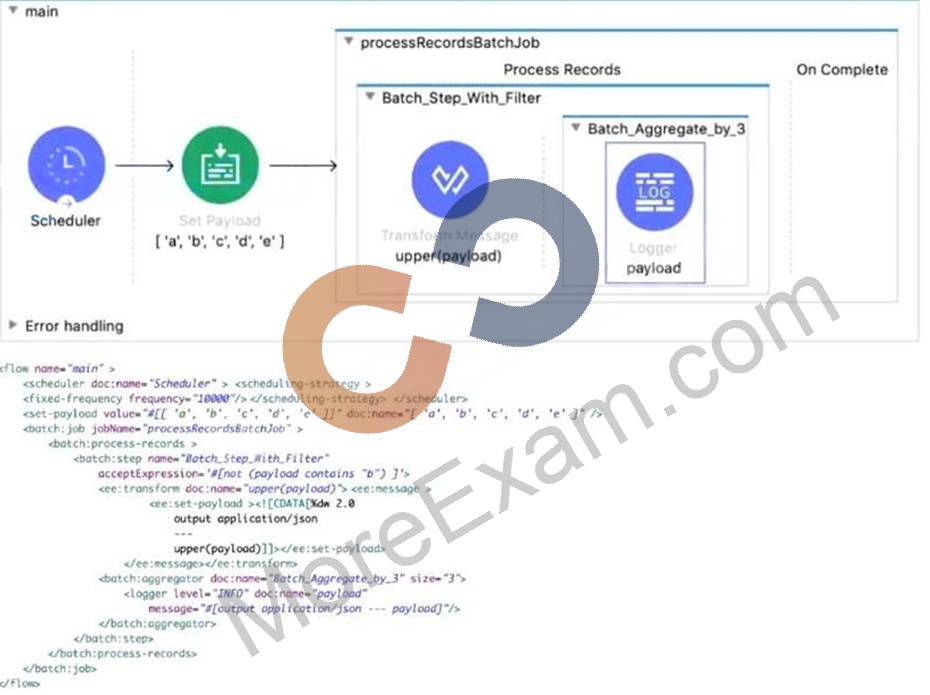
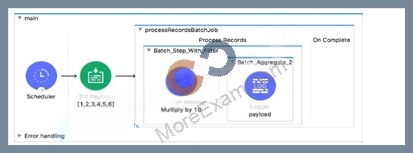
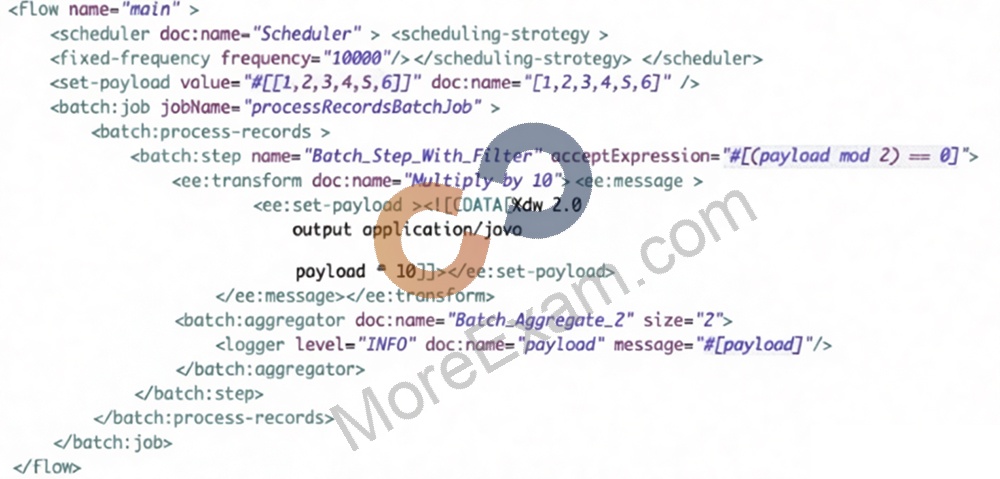
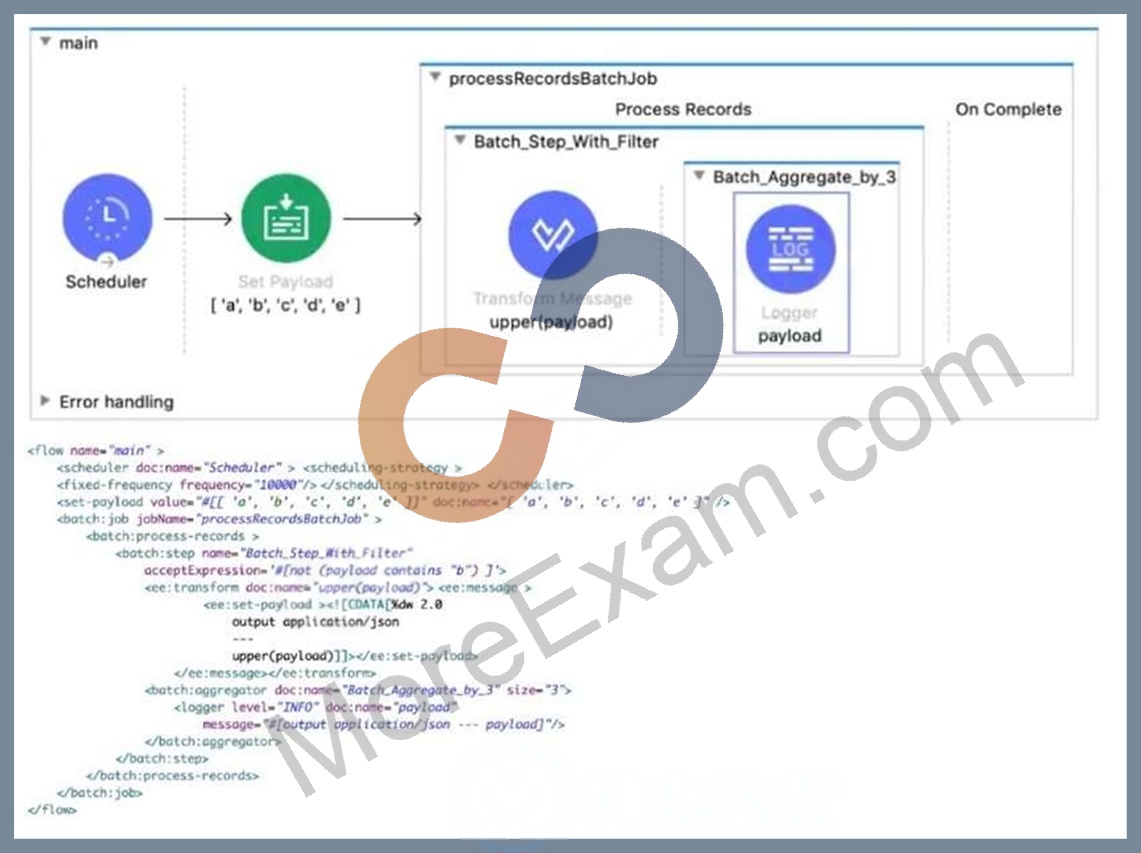
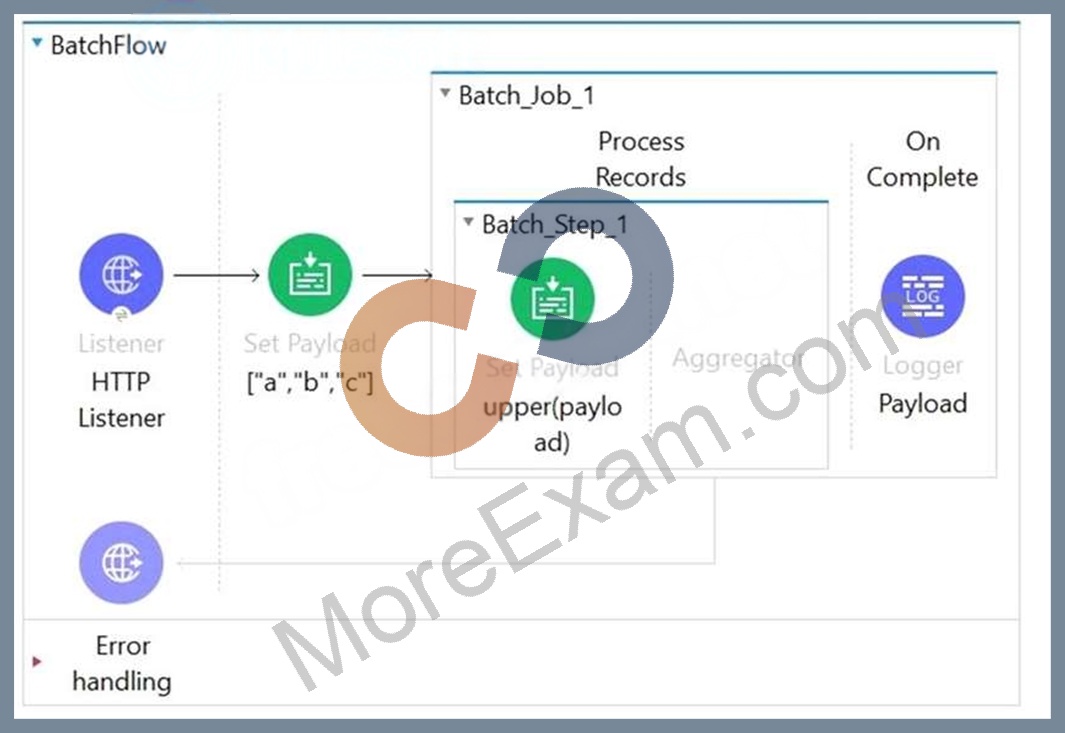
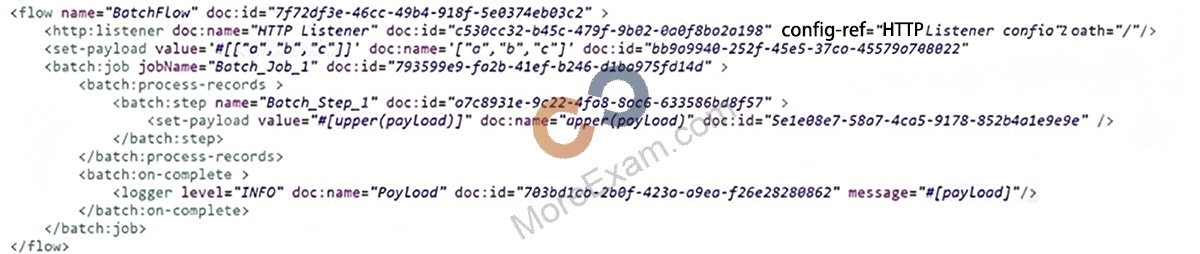
Question33: Refer to the exhibit. The Batch Job processes, filters and aggregates records, What is the expected output from the Logger component?

Question34: Refer to the exhibit.

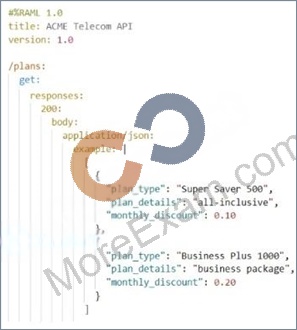
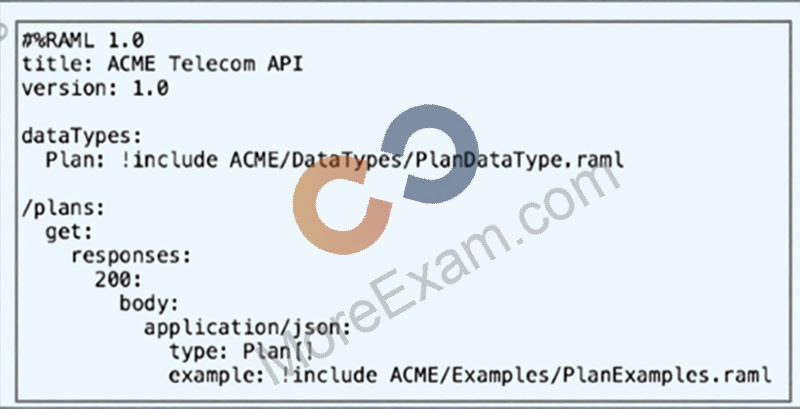
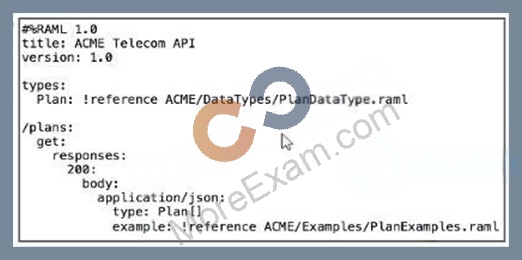
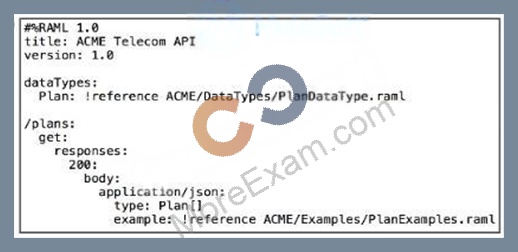
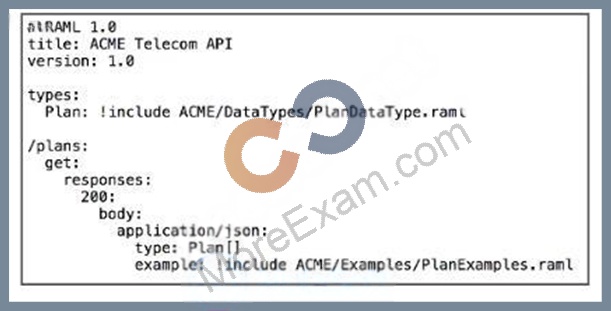
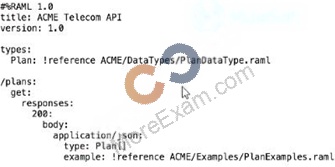
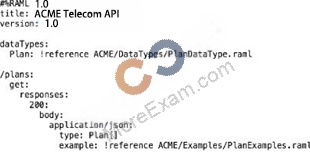
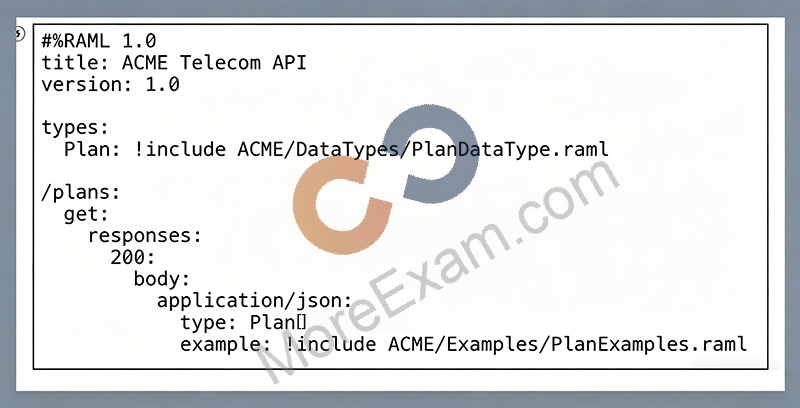
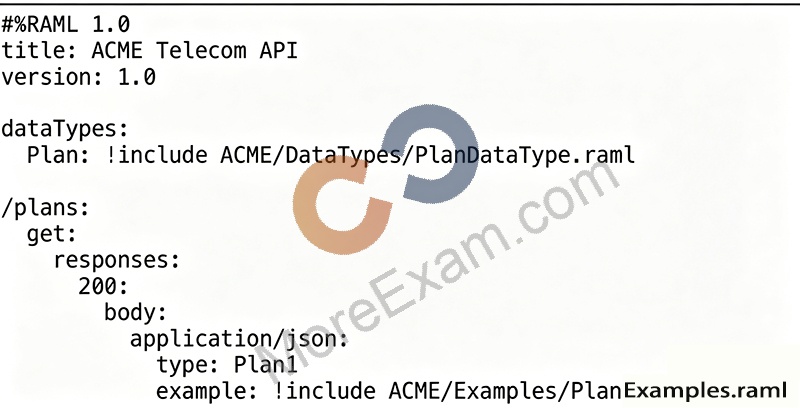
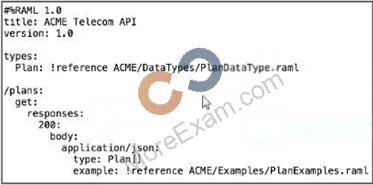
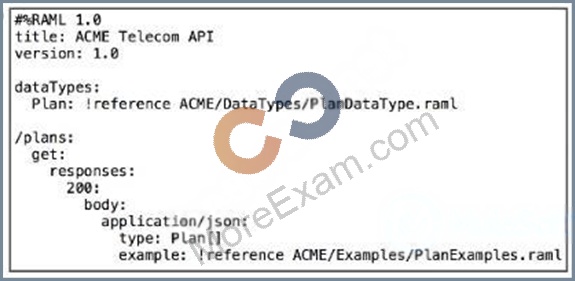
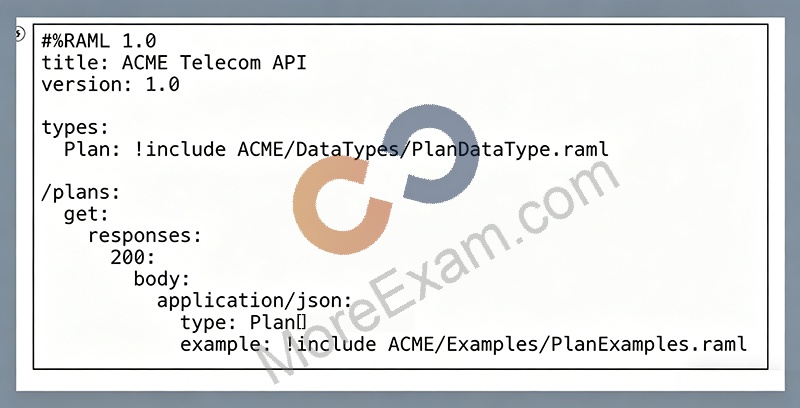
The API needs to be updated using the company-wide standard for the Plan data type. The Object data type has already been published in Anypoint Exchange with the global reference .
ACME/DataTypes/PlanDataType.raml.
What is a valid RAML specification that reuses the Plan data type?
A)

B)

C)

D)

Question35: Refer to the payload.


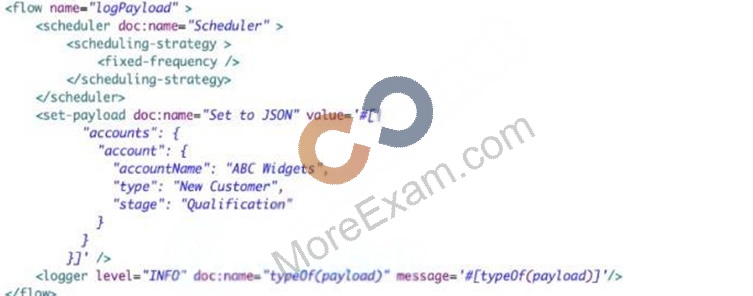
The Set payload transformer sets the payload to an object. The logger component's message attribute is configured with the string "Result #["INFO"++ payload]" What is the output of logger when this flow executes?

Question36: In the Database On Table Row operation, what does the Watermark column enable the On Table Row operation to do?

Question37: Refer to the exhibits.

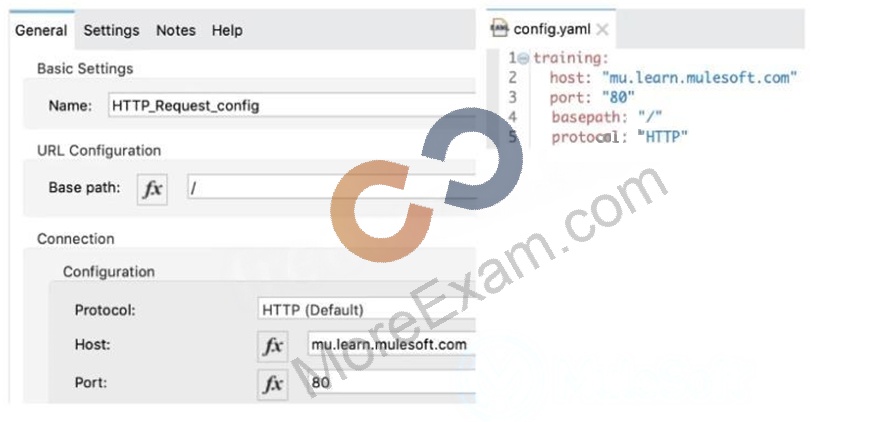
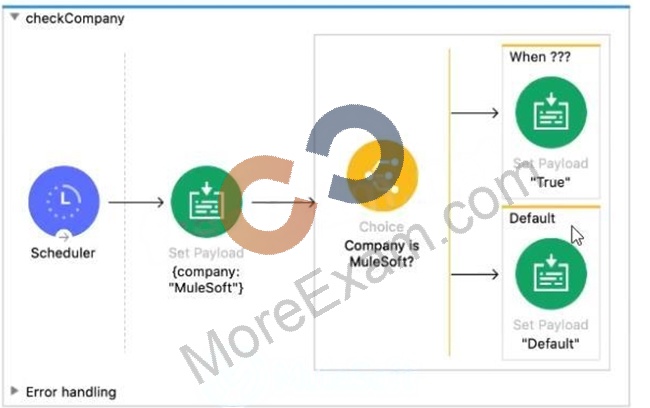
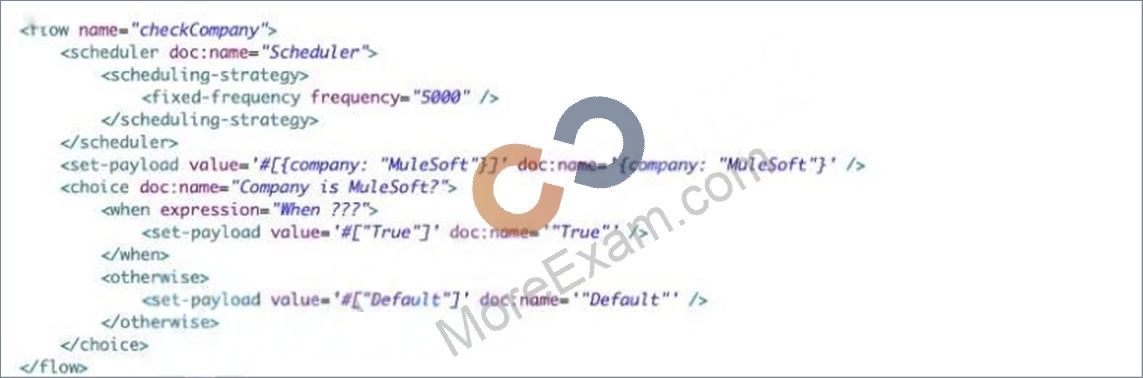
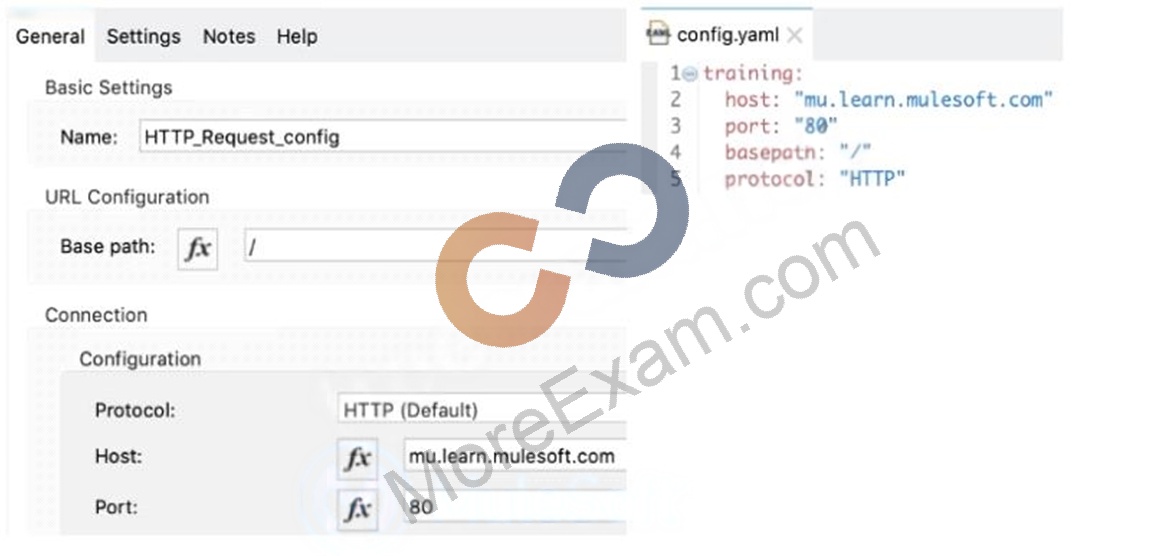
A Mule application has an HTTP Request that is configured with hardcoded values. To change this, the Mule application is configured to use a properties file named config.yaml.
what valid expression can the HTTP Request host value be set to so that it is no longer hardcoded?

Question38: Refer to the exhibits.

The input array of strings is processed by the batch job that processes, fitters, and aggregates the values.
What is the last message logged by the Logger component after the batch job completes processing?
A)

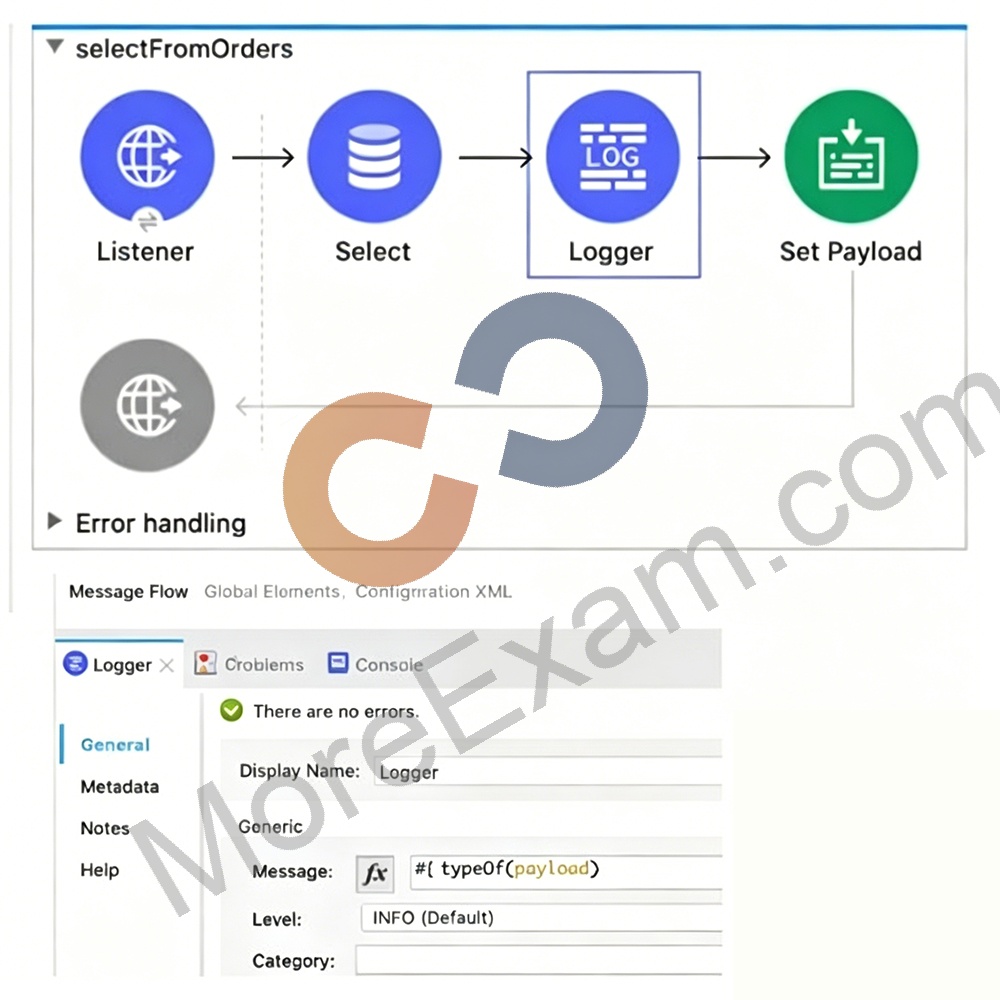
B)

C)

D)

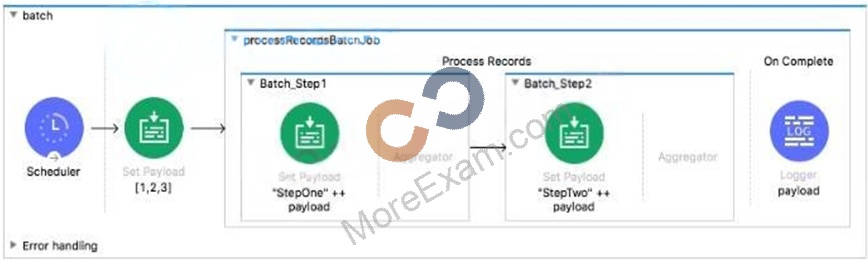
Question39: Refer to the exhibit. The input array of strings is passed to the batch job, which does NOT do any filtering or aggregating. What payload is logged by the Logger component?

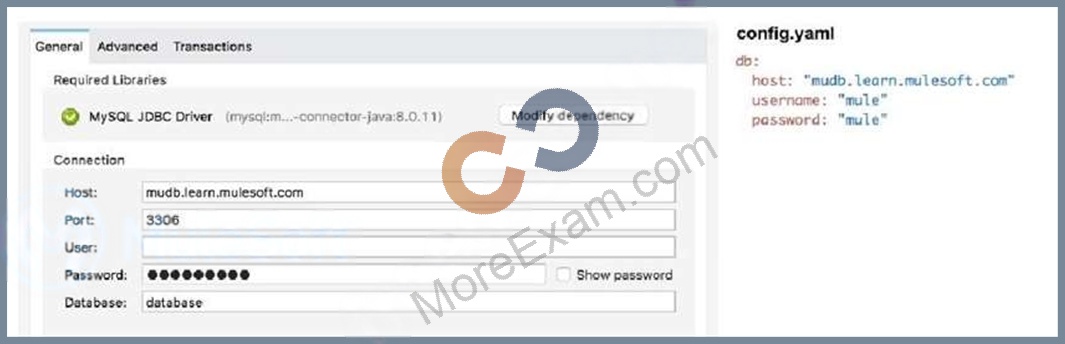
Question40: Refer to the exhibits.
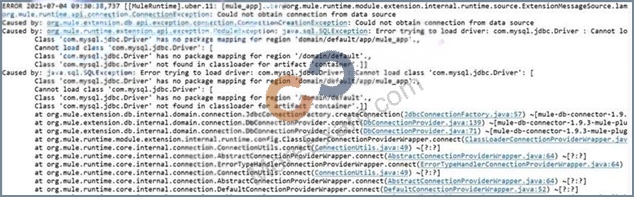
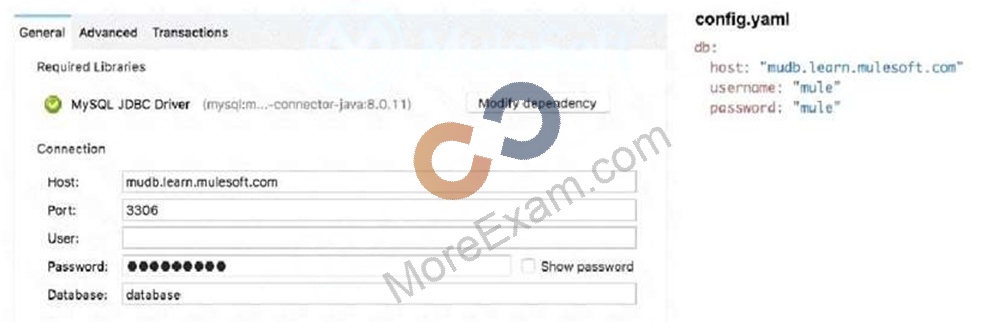
As a mulesoft developer, what you would change in Database connector configuration to resolve this error?

Question41: Refer to the exhibit. The Batch Job processes, filters and aggregates records, What is the expected output from the Logger component?

Question42: According to Mulesoft, how are Modern APIs treated as?

Question43: An API specification is designed using RAML. What is the next step to create a REST Connector from this API specification?

Question44: Refer to the exhibit.

A Mule event is composed of a hierarchy of objects. Where in the hierarchy are variables stored?

Question45: Refer to the exhibits.

The input array of strings is processed by the batch job that processes, fitters, and aggregates the values.
What is the last message logged by the Logger component after the batch job completes processing?
A)

B)

C)

D)

Question46: Refer to the exhibits. A web client sends a POST request to the HTTP Listener and the Validation component in the Try scope throws an error.
What response message is returned to the web client?

Question47: A Mule application contains a global error handler configured to catch any errors.
Where must the global error handler be specified so that the global error handler catches all errors from flows without their own error handlers?

Question48: What execution model is used by For Each and Batch Job scopes?

Question49: Refer to the exhibit.

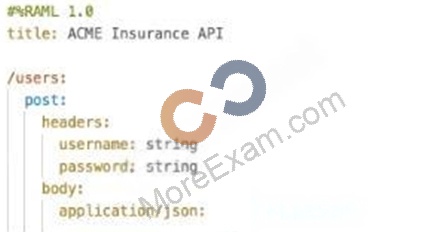
What is the correct way to create a user?
A)

B)

C)

D)

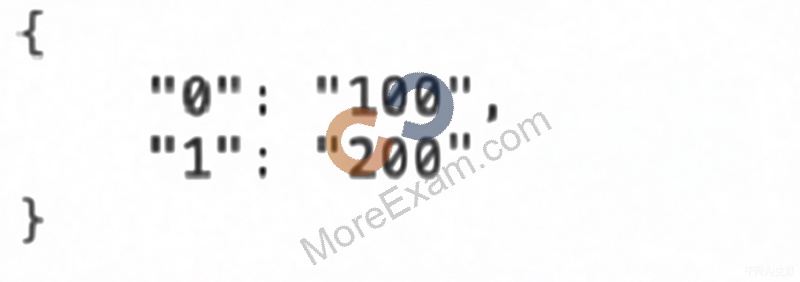
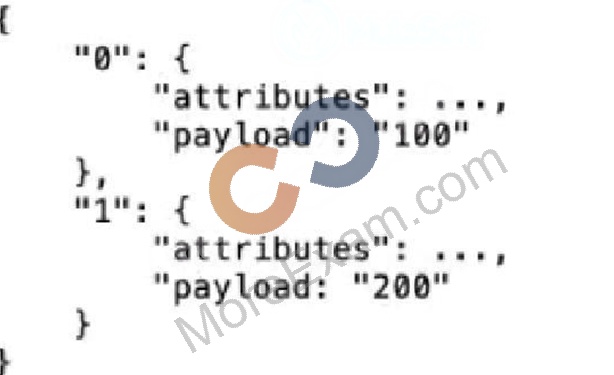
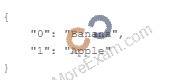
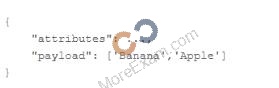
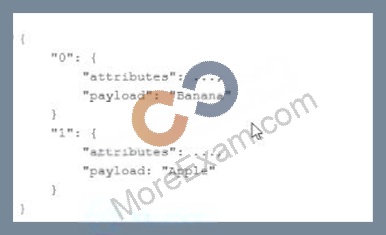
Question50: Refer to the exhibits.


A web client submits a request to http://localhQst:8081. What is the structure of the payload at the end of the flow?
A)

B)

C)

D)

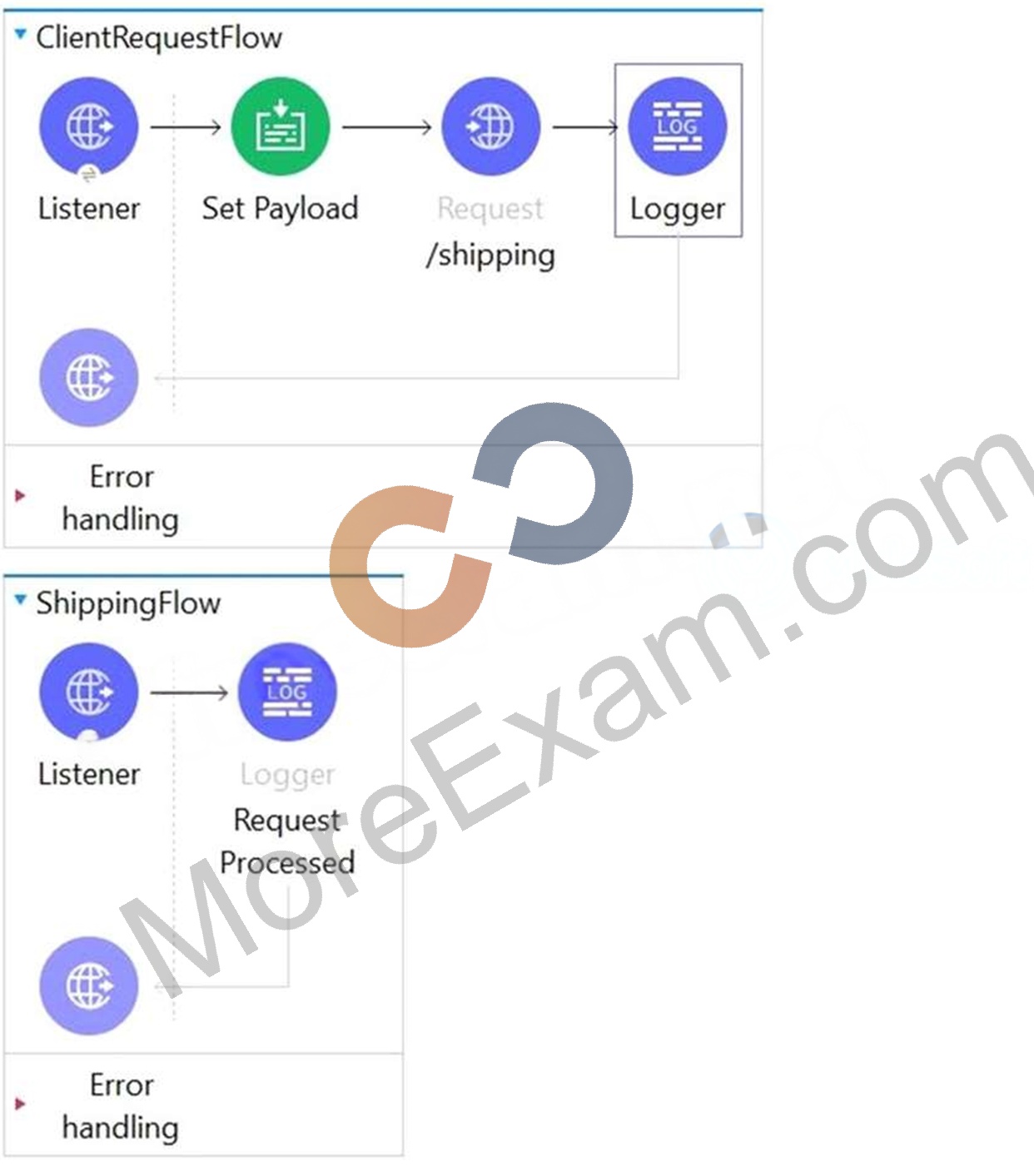
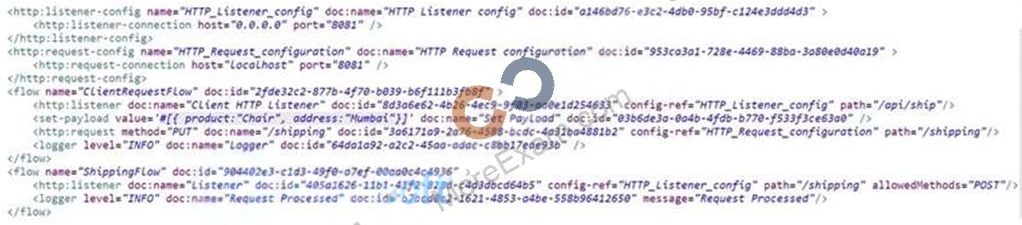
Question51: Refer to the exhibits. Client sends the request to ClientRequestFlow which calls ShippingFlow using HTTP Request activity.
During E2E testing it is found that that HTTP:METHOD_NOT_ALLOWED error is thrown whenever client sends request to this flow.
What attribute you would change in ClientRequestFlow to make this implementation work successfully?


Question52: Refer to the exhibits.


A
web client submits a request to http://localhQst:8081 /flights. What is the result at the end of the flow?

Question53: What valid RAML retrieves details on a specific by its orderld as a URL parameter?
A)

B)

C)

D)

Question54: An app team is developing a mobile banking app. It took them two months to create their own APIs to access transaction information from a central database. The app team later found out that another team had already built an API that accesses the transaction information they need.
According to MuleSoft, what organization structure could have saved the app team two months of development time?

Question55: An app team is developing a mobile banking app. It took them two months to create their own APIs to access transaction information from a central database. The app team later found out that another team had already built an API that accesses the transaction information they need.
According to MuleSoft, what organization structure could have saved the app team two months of development time?

Question56: Refer to the exhibit.

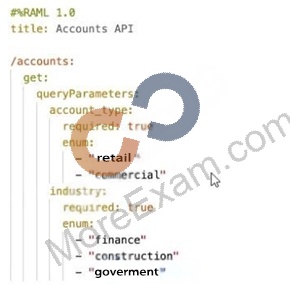
This RAML specification includes a resource and method to retrieve accounts by account_type and industry.
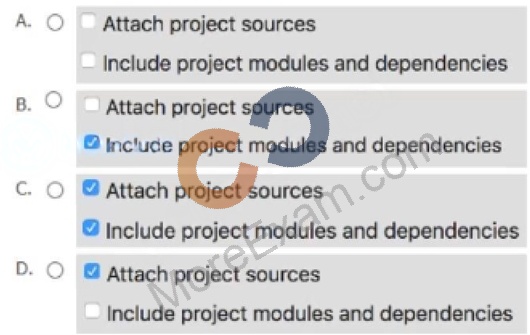
What is the correct URI to get all retail finance accounts?

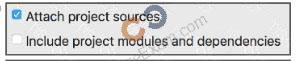
Question57: A Mule application contains an ActiveMQ JMS dependency. The Mule application was developed in Anypoint Studio and runs successfully in Anypoint Studio.
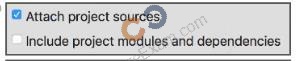
The Mule application must now be exported from Anypoint Studio and shared with another developer.
What export options create the smallest JAR file that can be imported into the other developer's Anypoint Studio and run successfully?

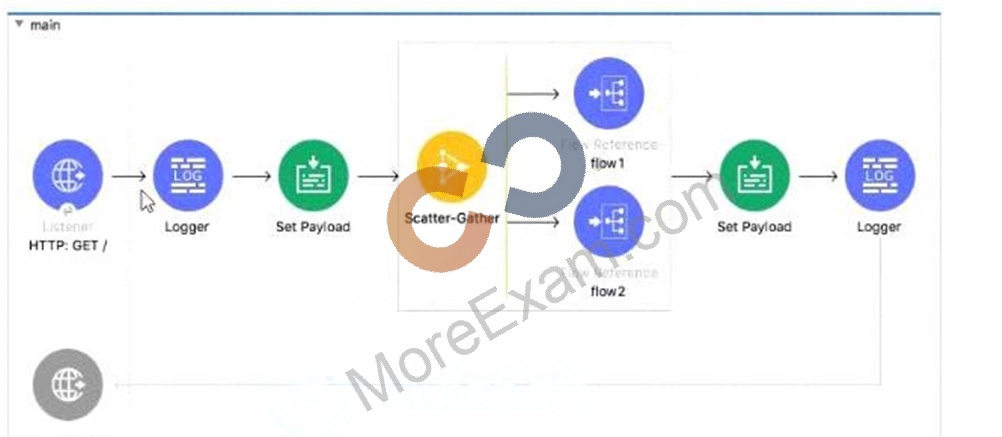
Question58: Refer to the exhibit.

In the execution of the Scatter_Gather, the flow1 route completes after 10 seconds and the flow2 route completes after 20 seconds.
How many seconds does it take for the Scatter_Gather to complete?

Question59: Refer to the exhibit.


What payload is returned from a request to http//localhost.8081/
Refer
to the exhibits, what payload is returned from a request to http://localhost;8081/?

Question60: Refer to the exhibit.


What payload is returned from a request to http//localhost.8081/
Refer
to the exhibits, what payload is returned from a request to http://localhost;8081/?

Question61: Refer to the exhibits.
A web client sends a GET request to the HTTP Listener.
What response message is returned to the web client?

Question62: Why would a Mule application use the ${http.port} property placeholder for its HTTP Listener port when it is deployed to CloudHub?

Question63: What is the main purpose of flow designer in Design Center?

Question64: Refer to the exhibits. A company has defined this Book data type and Book example to be used in APIs. What is valid RAML for an API that uses this Book data type and Book example?

A)

B)

C)

D)

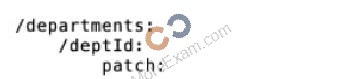
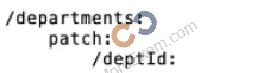
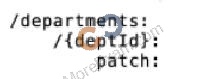
Question65: A company has an API to manage departments, with each department identified by a unique deptld. The API was built with RAML according to MuleSoft best practices.
What is valid RAML to specify a method to update the details for a specific department?
A)

B)

C)

D)

Question66: Refer to the exhibits.


A
web client submits a request to http://localhQst:8081. What is the structure of the payload at the end of the flow?
A)

B)

C)

D)

Question67: Refer to the exhibits.

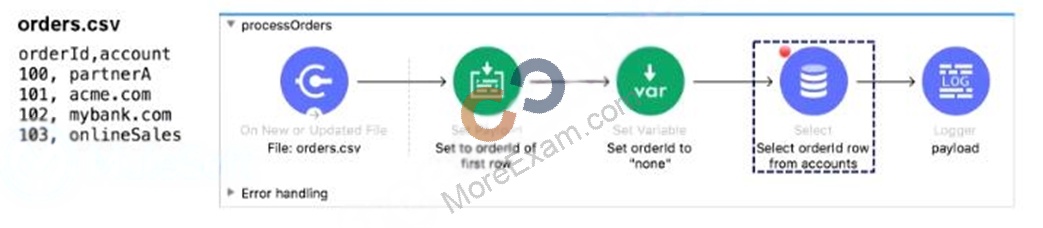
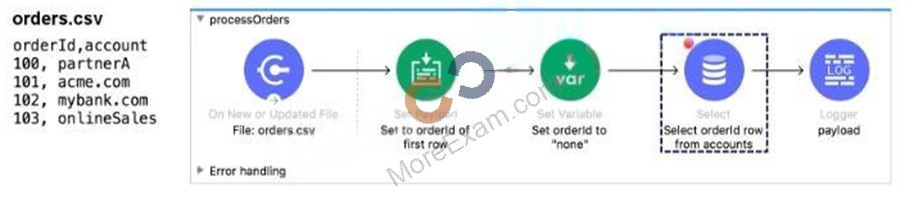
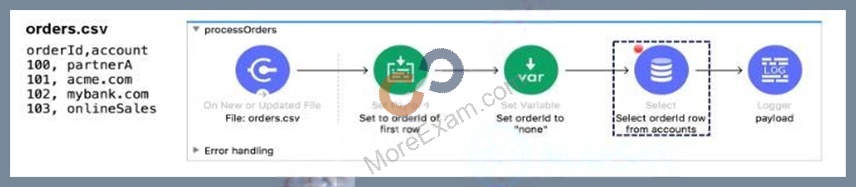
The orders.csv file is read, then processed to look up the orders in a database. The Mule application is debugged in Any point Studio and stops at the breakpoint.
What is the payload shown in the debugger at this breakpoint?

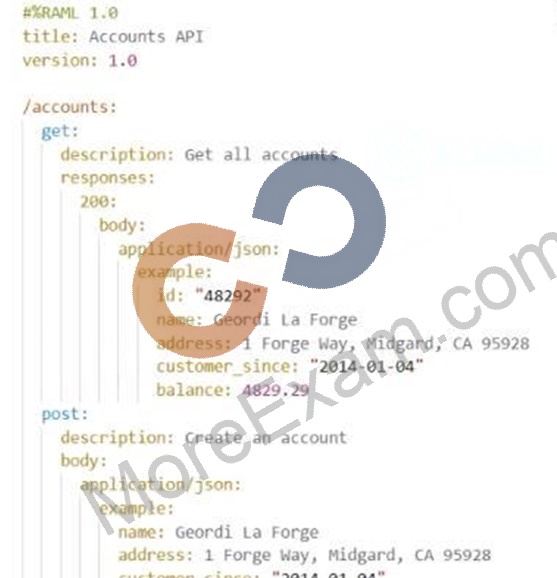
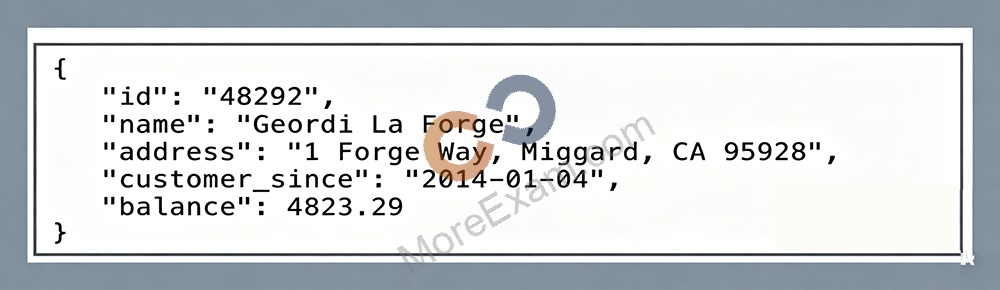
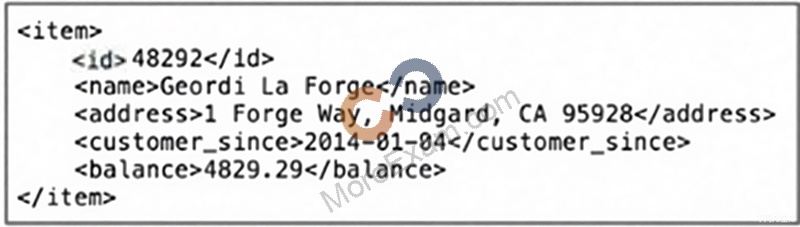
Question68: Refer to the exhibit.

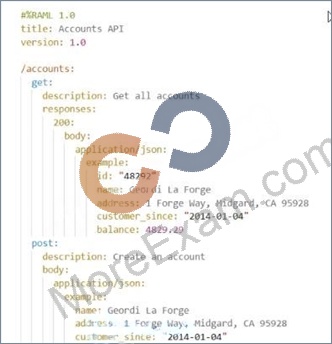
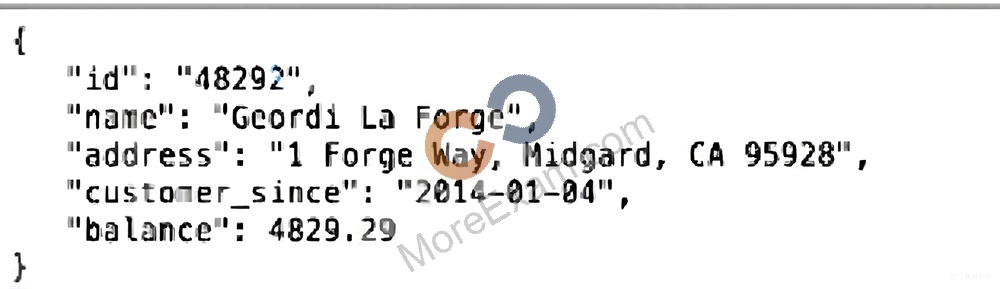
What data is expected by the POST /accounts endpoint?
A)

B)

C)

D)

Question69: What valid RAML retrieves details on a specific by its orderld as a URL parameter?
A)

B)

C)

D)

Question70: A
web client submits a request to http://localhost:8081/books/0471767840. The value
"0471767840" is captured by a Set Variable transformer to a variable named booklSBN.
What is the DataWeave expression to access booklSBN later in the flow?

Question71: Refer to the exhibit.

What should be changed to fix the 415 error?

Question72: Refer to the exhibits.


The Validation component in the Try scope throws an error.
What response message is returned to a client request to the main flow's HTTP Listener?
The Validation component in the Try scope throws an error. What response message is returned to a client request to the main flow's HTTP Listener?

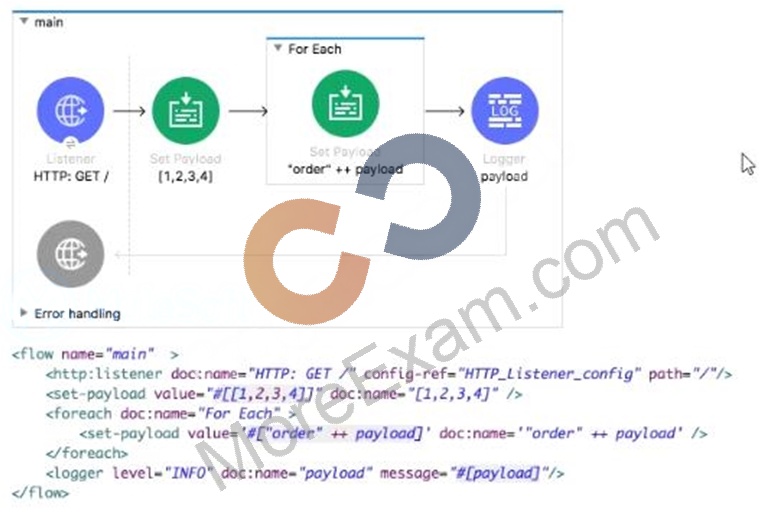
Question73: Refer to the exhibits. What payload is logged at the end of the main flow?

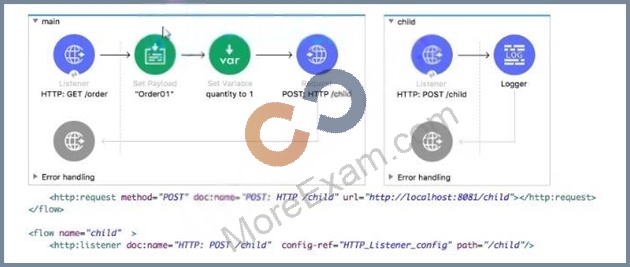
Question74: Refer to the exhibits.

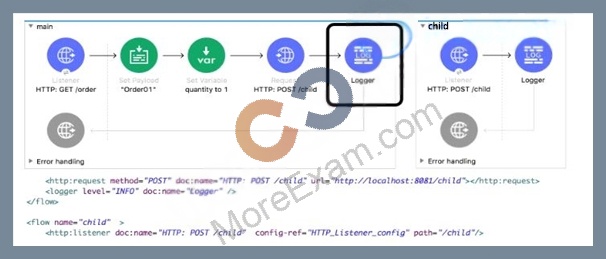
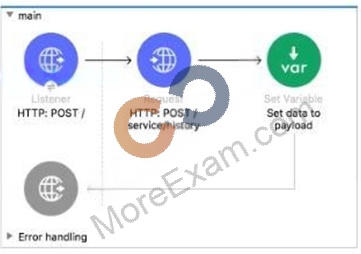
The main flow contains an HTTP Request. The HTTP Listeners and HTTP Request use default configurations.
What
values are accessible in the child flow after a web client submits a request to http://localhost:8081/order? col or
= red?

Question75: How we can scale deployed Mule application vertically on cloudhub?

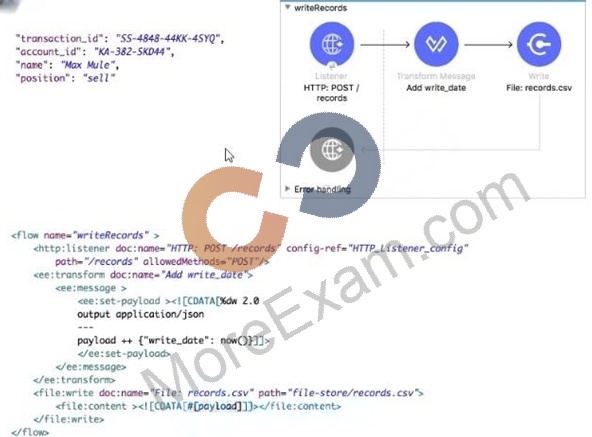
Question76: Refer to the exhibits.

What is written to the records.csv file when the flow executes?

Question77: Refer to the exhibit.

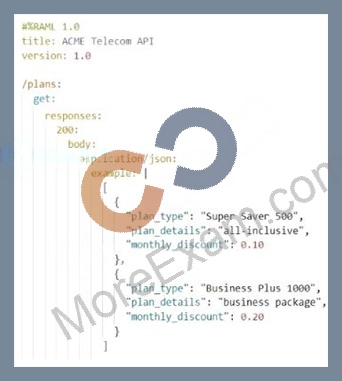
The API needs to be updated using the company-wide standard for the Plan data type. The Object data type has already been published in Anypoint Exchange with the global reference . ACME/DataTypes/PlanDataType.raml.
What is a valid RAML specification that reuses the Plan data type?
A)

B)

C)

D)

Question78: Refer to the exhibit.

The API needs to be updated using the company-wide standard for the Plan data type. The Object data type has already been published in Anypoint Exchange with the global reference .
ACME/DataTypes/PlanDataType.raml.
What is a valid RAML specification that reuses the Plan data type?
A)

B)

C)

D)

Question79: By default, what happens to a file after it is read using an FTP connector Read operation?

Question80: Refer to the exhibit.

All three of the condition for the Choice router are true. What log messages are written?

Question81: Refer to the exhibit.

What is the correct DataWeave expression for the Set Payload transformer to call the createCustomerObject flow with values for the first and last names of a new customer?

Question82: A Mule project contains a MySQL Database dependency. The project is exported from Anypoint Studio so it can be deployed to CloudHub.
What export options create the smallest deployable archive that will successfully deploy to CloudHub?
What export option create their smallest deployable archive that will successfully deploy to CloudHub?
A)

B)

C)

D)

Question83: Refer to the exhibits.

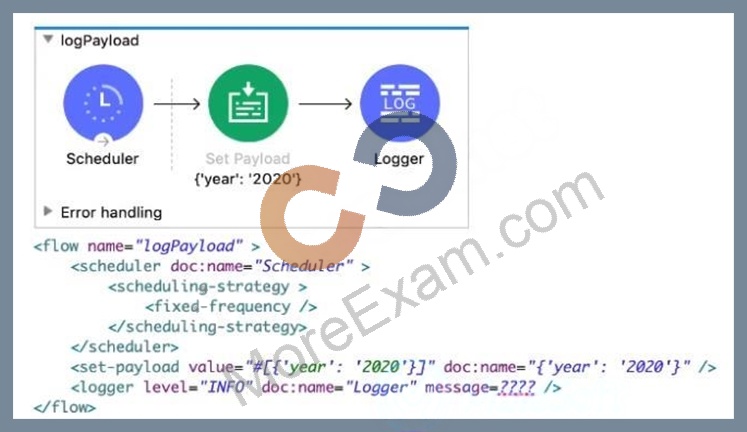
The Set Payload transformer's value is set to {'year': '2020'}.
What message value should be added to the Logger component to output the message 'The year is 2020', without hardcoding 2020?

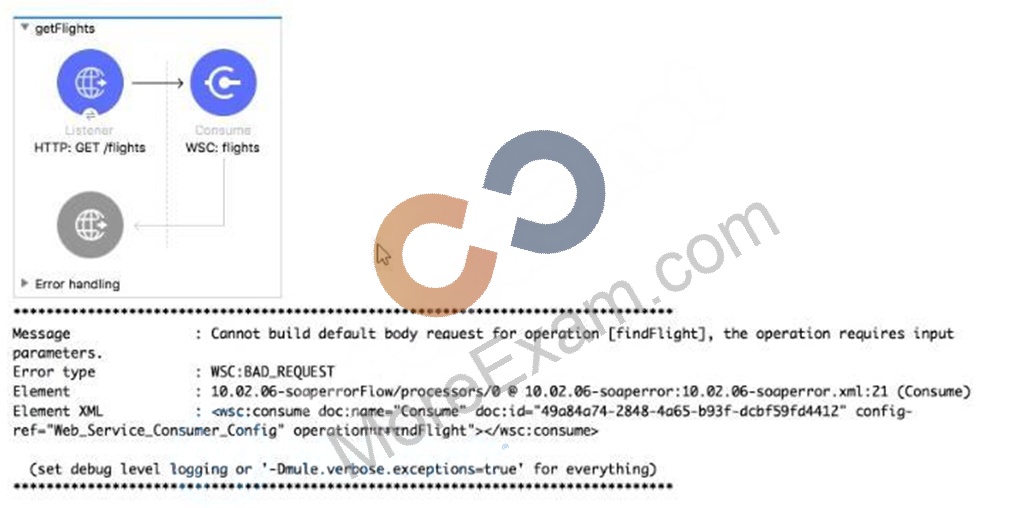
Question84: Refer
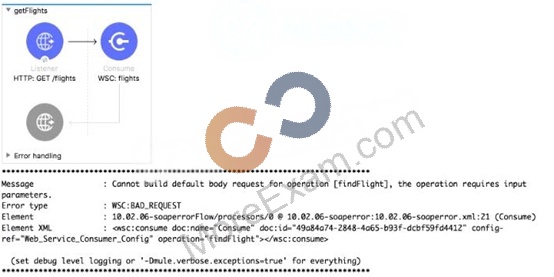
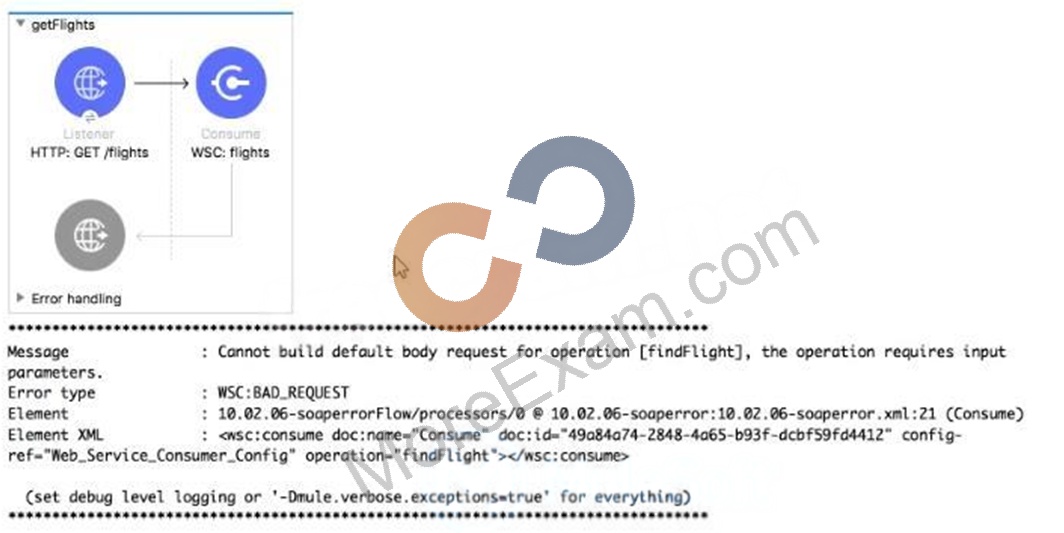
to the exhibits. A web client submits a request to http://localhost:8081/fliqhts?destination=SFO and the Web Service Consumer throws a WSC:BAD_REQUEST error.
What is the next step to fix this error?

Question85: What is output of Dataweave flatten function?

Question86: What is the output type of the DataWeave map operator?

Question87: Refer to the exhibits.

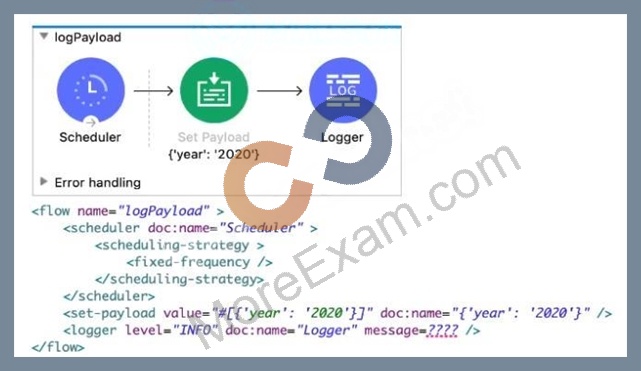
The Set Payload transformer's value is set to {'year': '2020'}.
What message value should be added to the Logger component to output the message 'The year is 2020', without hardcoding 2020?

Question88: A
web client submits a request to http://localhost:8081?accountType=personal. The query parameter is captured using a Set Variable transformer to a variable named accountType.
What is the correct DataWeave expression to log accountType?

Question89: Why would a Mule application use the ${http.port} property placeholder for its HTTP Listener port when it is deployed to CloudHub?

Question90: Refer to the exhibits.

The orders.csv file is read, then processed to look up the orders in a database. The Mule application is debugged in Any point Studio and stops at the breakpoint.
What is the payload shown in the debugger at this breakpoint?

Question91: Refer to the exhibits.

The web client sends a POST request to the ACME Order API with an XML payload. An error is returned.
What should be changed in the request so that a success response code is returned to the web client?

Question92: Refer to the exhibit.

What is the output payload in the On Complete phase

Question93: Which of the module is imported automatically in Dataweave scripts?

Question94: Refer to the exhibits.

The input array of strings is processed by the batch job that processes, filters, and aggregates the values. What is the last message logged by the Logger component after the batch job completes processing?

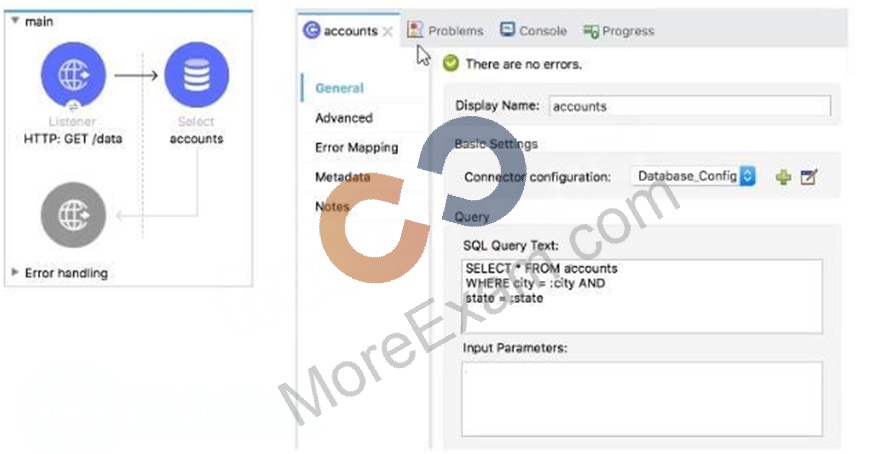
Question95: Refer to the exhibit.

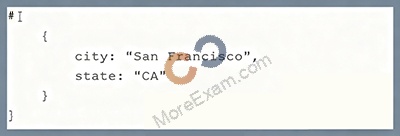
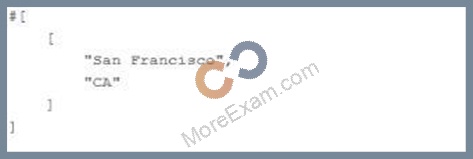
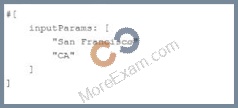
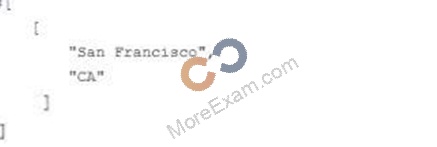
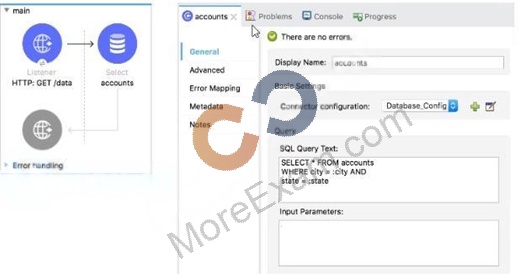
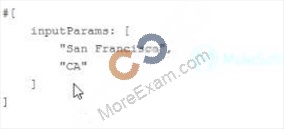
What expression correctly specifies input parameters to pass the city and state values to the SQL query?
A)

B)

C)

D)

Question96: Refer to the exhibit.

What is the correct DataWeave expression for the Set Payload transformer to call the createCustomerObject flow with values for the first and last names of a new customer?

Question97: A
Mule application contains two HTTP Listeners, each configured for different API endpoints:
http://acme.com/apis/orders and http: //acme .com/a pis/customers.
What base path value should be set in an HTT? Listener config element so that it can be used to configure both HTTP Listeners?

Question98: Refer to the exhibit.

What DataWeave expression transforms the conductorlds array to the XML output?
A)

B)

C)

D)

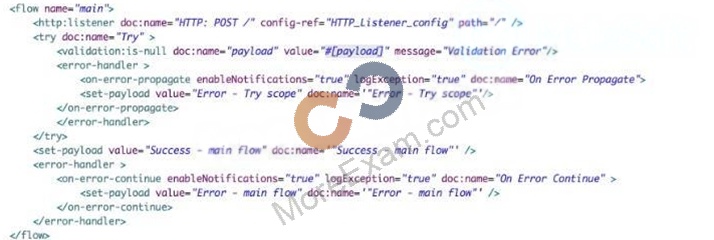
Question99: Refer to the exhibit.

What is the response to a web client request to http://localhost:8081?
Question100: Refer to the exhibit.

In the execution of the Scatter_Gather, the flow1 route completes after 10 seconds and the flow2 route completes after 20 seconds.
How many seconds does it take for the Scatter_Gather to complete?

Question101: What is the correct Syntax to add a customer ID as a URI parameter in the HTTP listener's path attribute?

Question102: Refer to the exhibits.
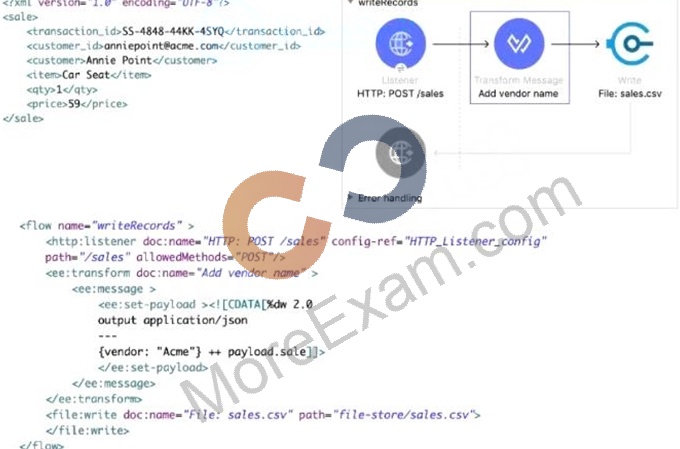
A web client sends sale data in a POST request to the Mule application. The Transform Message component then enrich the payload by prepending a vendor name to the sale data.
What is written to the sales.csv file when the flow executes?

Question103: Refer to the exhibits.


The <when> expression for the Choice router needs to be written.
What is a valid <when> expression to route Mule events to the non-default flow?

Question104: An HTTP Request operation sends an HTTP request with a non-empty JSON object payload to an external HTTP endpoint. The response from the external HTTP endpoint returns an XML body. The result is stored in a target named the Result.
What is the payload at the event processor after the HTTP Request?

Question105: Refer to the exhibit.

The Database Select operation returns five rows from a database. What is logged by the Logger component?

Question106: What is the trait name you would use for specifying client credentials in RAML?

Question107: Refer to the exhibits.


A JSON payload is set in the Set Payload transformer.
What is logged by the Logger?

Question108: Which of the below is not a valid category for connector type?

Question109: Refer to the exhibit. The main flow contains an HTTP Request in the middle of the flow. The HTTP Listeners and HTTP request use default configurations.
What values are accessible to the Logger at the end of the flow after a web client submit request to http://local:801/order?color=red?

Question110: Refer to the exhibit.

What data is expected by the POST /accounts endpoint?
A)

B)

C)

D)

Question111: Refer to the exhibits.

What is valid text to set the field in the Database connector configuration to the username value specified in the config.yaml file?

Question112: Refer to the exhibits. The main flow contains an HTTP Request in the middle of the flow. The HTTP Listeners and HTTP Request use default configurations.
A web client submits a request to the main flow's HTTP Listener that includes query parameters for the pedigree of the piano.
What values are accessible to the Logger component at the end of the main flow?

Question113: A flow contains an HTTP Listener as the event source. What is the DataWeave expression to log the Content-Type header using a Logger component?

Question114: Refer
to the exhibits. A web client submits a request to http://localhost:8081/fliqhts?destination=SFO and the Web Service Consumer throws a WSC:BAD_REQUEST error.
What is the next step to fix this error?

Question115: Refer to the exhibit.

What is a valid expression for the Choice router's when expression to route events to the documenticShipping flow?

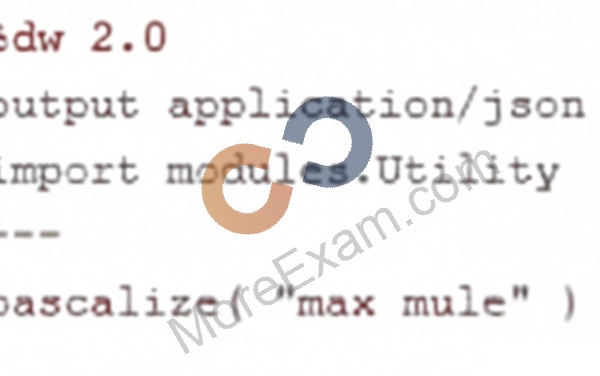
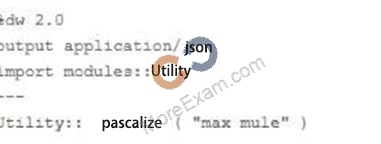
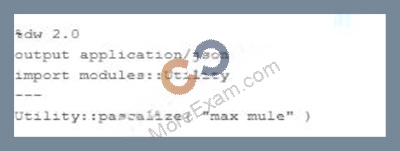
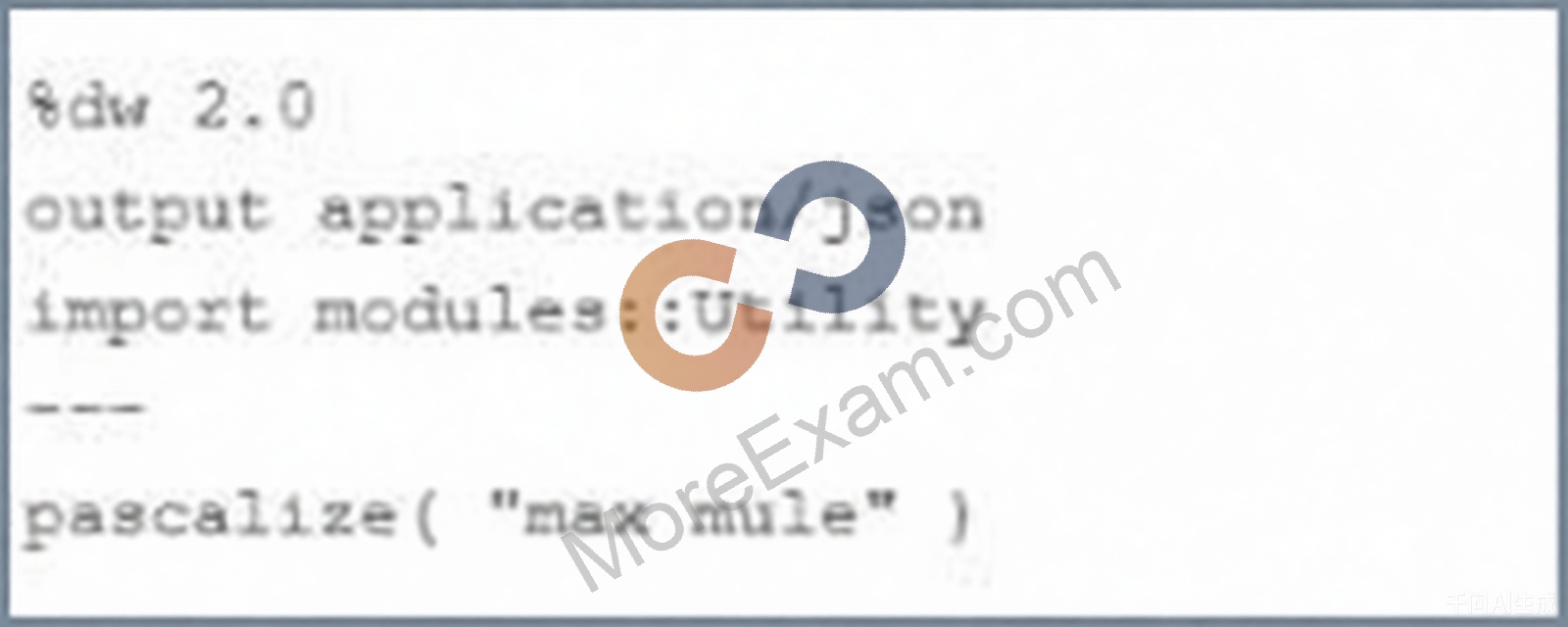
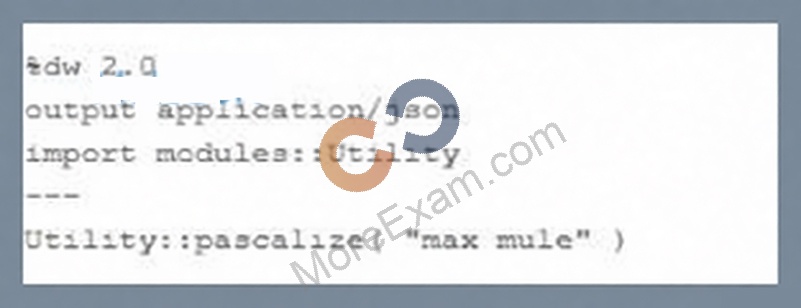
Question116: A Utility.dwl file is located in a Mule project at src/main/resources/modules. The Utility.dwl hie defines a function named pascalize that reformats strings to pascal case.
What is the correct DataWeave to call the pascalize function in a Transform Message component?
A)

B)

C)

D)

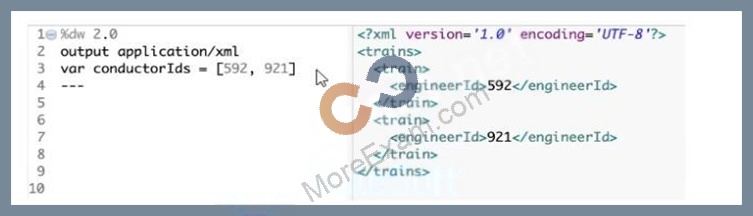
Question117: Refer to the exhibit.

What is the response to a web client request to
Question118: Mule application contains ActiveMQ JMS dependency. Mule application was compiled and run successfully in Anypoint Studio. The mule application must now be exported from Anypoint Studio and shared with other developer. What export options should be selected to create the smallest JAR file that can be imported into other developer's Anypoint Studio and run successfully?

Question119: A Mule project contains a MySQL Database dependency. The project is exported from Anypoint Studio so it can be deployed to CloudHub.
What export options create the smallest deployable archive that will successfully deploy to CloudHub?
What export option create their smallest deployable archive that will successfully deploy to CloudHub?
A)

B)

C)

D)

Question120: Refer to the exhibits.

A Mule application has an HTTP Request that is configured with hardcoded values. To change this, the Mule application is configured to use a properties file named config.yaml.
what valid expression can the HTTP Request host value be set to so that it is no longer hardcoded?

Question121: Refer to the exhibit.


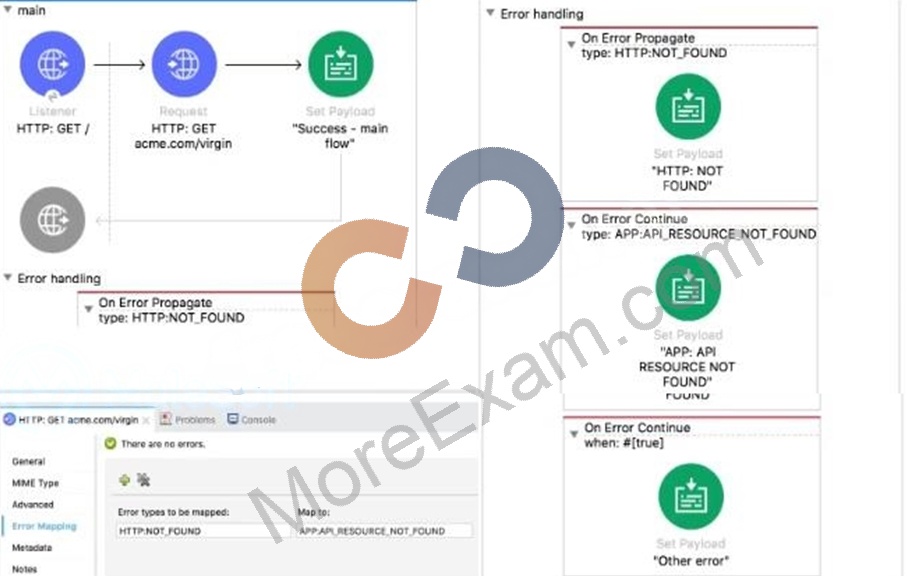
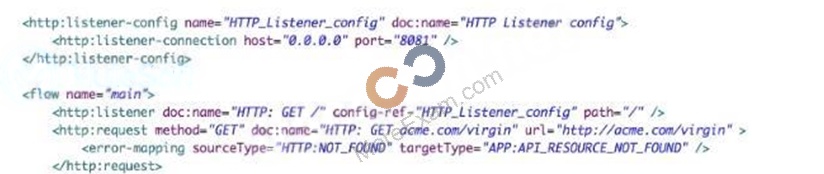
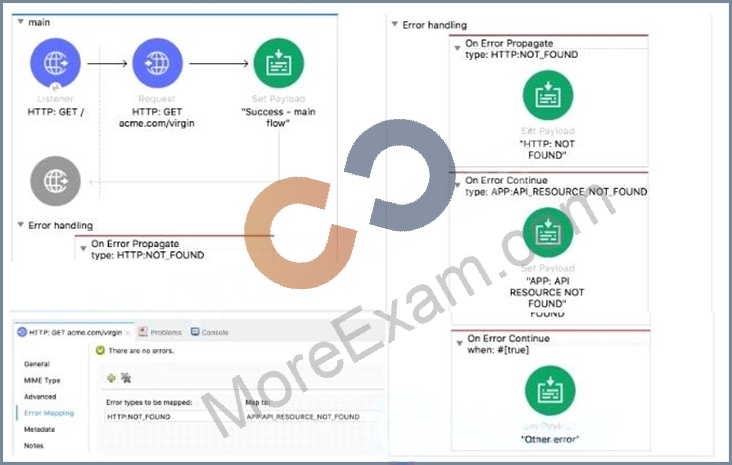
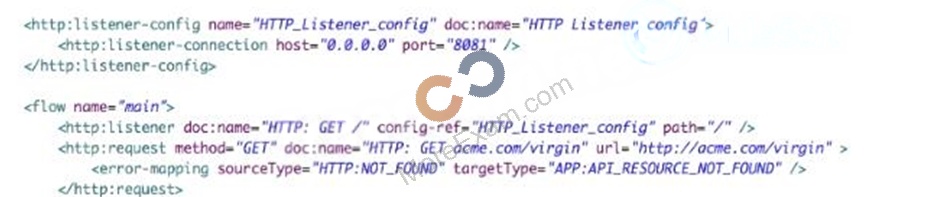
The main flow is configured with their error handlers. A web client submit a request to the HTTP Listener and the HTTP Request throws an HTTP:NOT_FOUND error.
What response message is returned?''
What response message is returned?

Question122: Refer to the exhibits.

The orders.csv file is read, then processed to look up the orders in a database. The Mule application is debugged in Any point Studio and stops at the breakpoint.
What is the payload shown in the debugger at this breakpoint?

Question123: A web client sends a request to http;//localhost:8081?dept=sales. What is the correct DataWeave expression to access the value of dept?

Question124: What path setting is required for an HTTP Listener endpoint to route all requests to an APIkit router?

Question125: Refer to the exhibits. A web client submits a request to http://localhost:8081/fliqhts?destination=SFO and the Web Service Consumer throws a WSC:BAD_REQUEST error.
What is the next step to fix this error?

Question126: What MuleSoft API-led connectivity layer is intended to expose part of a backend database without business logic?

Question127: What is the output type of the DataWeave map operator?

Question128: An API specification is designed using RAML. What is the next step to create a REST Connector from this API specification?

Question129: What is the correct syntax to define and call a function in Database?
A)

B)

C)

D)

Question130: Following Mulesoft's recommended API-led connectivity approach , an organization has created an application network. The organization now needs to create API's to transform , orchestrate and aggregate the data provided by the other API's in the application network. This API should be flexible enought ot handle the data from additional API's in future.
According to Mulesoft's recommended API-led connectivity approach , what is the best layer for this new API?

Question131: Refer to the exhibits.


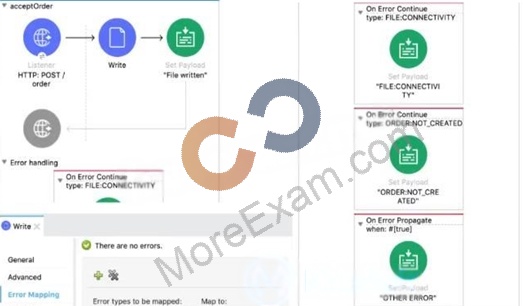
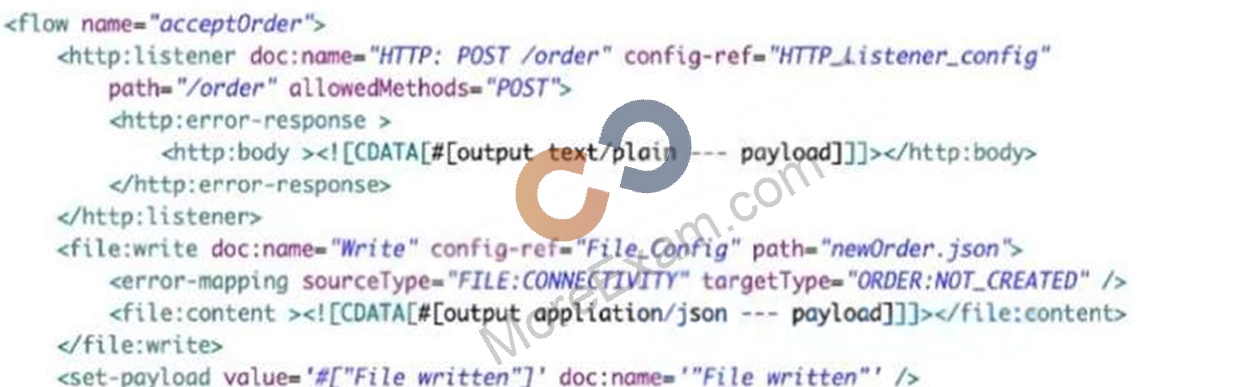
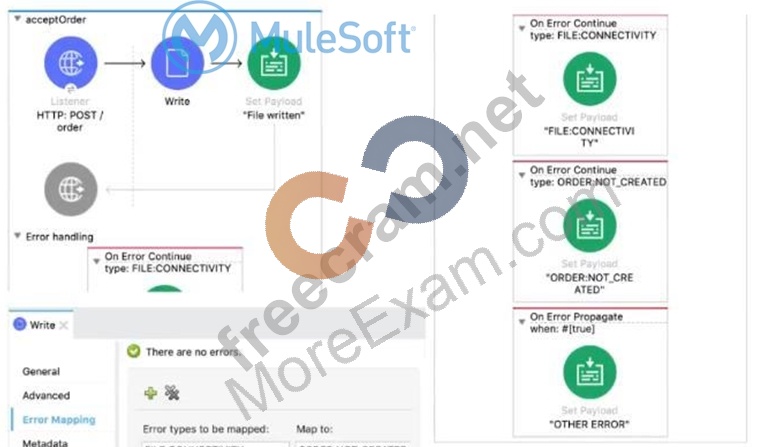
A web client sends a POST request with the payload {"oid": "1000", "itemid": "AC200", "qty": "4" } to the Mule application. The File Write operation throws a FILE:CONNECTIVITY error.
What response message is returned to the web client?

Question132: Refer to the exhibit.

What expression correctly specifies input parameters to pass the city and state values to the SQL query?
A)

B)

C)

D)

Question133: What is minimal requirement in a flow for a Mule application to compile?

Question134: Refer to the exhibit.


The main flow is configured with their error handlers. A web client submit a request to the HTTP Listener and the HTTP Request throws an HTTP:NOT_FOUND error.
What response message is returned?''
What response message is returned?

Question135: What is the correct syntax for a Logger component to output a message with the contents of a 3SON Object payload?

Question136: An SLA based policy has been enabled in API Manager. What is the next step to configure the API proxy to enforce the new SLA policy?

Question137: Refer to the exhibits.


A web client sends a POST request with the payload {"oid": "1000", "itemid": "AC200", "qty": "4" } to the Mule application. The File Write operation throws a FILE:CONNECTIVITY error.
What response message is returned to the web client?

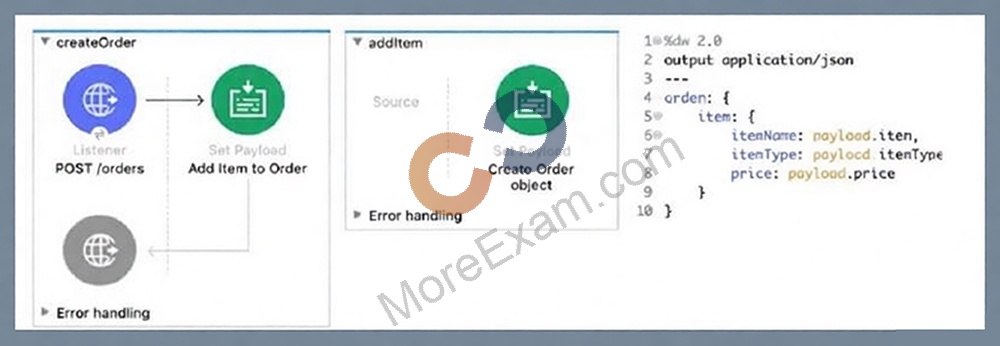
Question138: Refer to the exhibits. The Set Payload transformer in the addltem child flow uses DataWeave to create an order object.
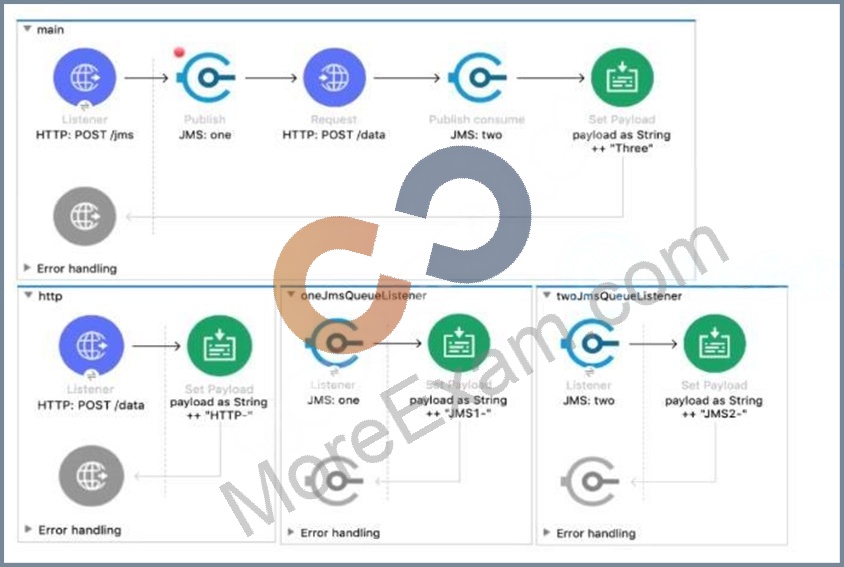
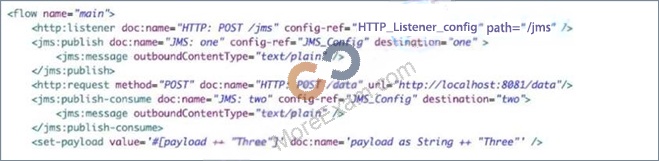
What is the correct DataWeave code for the Set Payload transformer in the createOrder flow to use the addltem child flow to add a router call with the price of 100 to the order?

Question139: Refer to the exhibit. The Batch Job processes, filters and aggregates records, What is the expected output from the Logger component?

Question140: By default, what happens to a file after it is read using an FTP connector Read operation?

Question141: Refer to the exhibits.


A Mule application contains a Choice router. What is logged when the flow completes?

Question142: Refer to the exhibits.
A web client sends a GET request to the HTTP Listener.
What response message is returned to the web client?

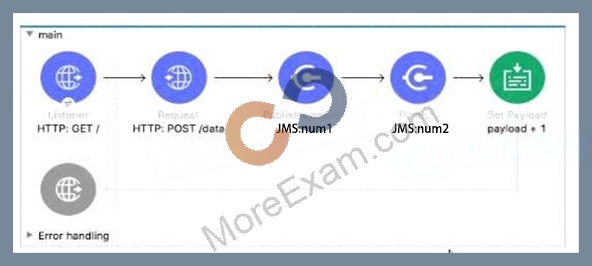
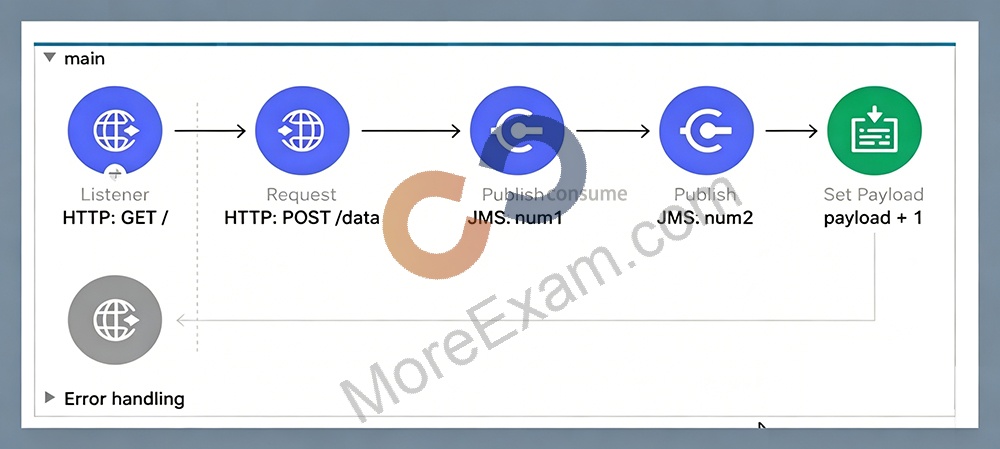
Question143: A flow has a JMS Publish consume operation followed by a JMS Publish operation. Both of these operations have the default configurations. Which operation is asynchronous and which one is synchronous?

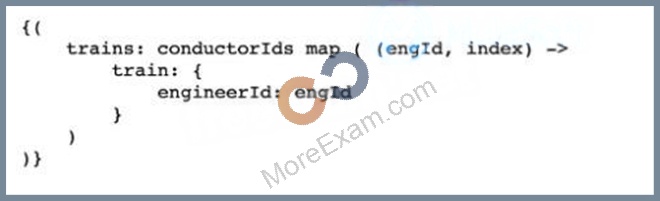
Question144: Refer to the exhibit.

What is the response to a web client request to
Question145: Refer to the exhibit.

What should be changed to fix the 415 error?
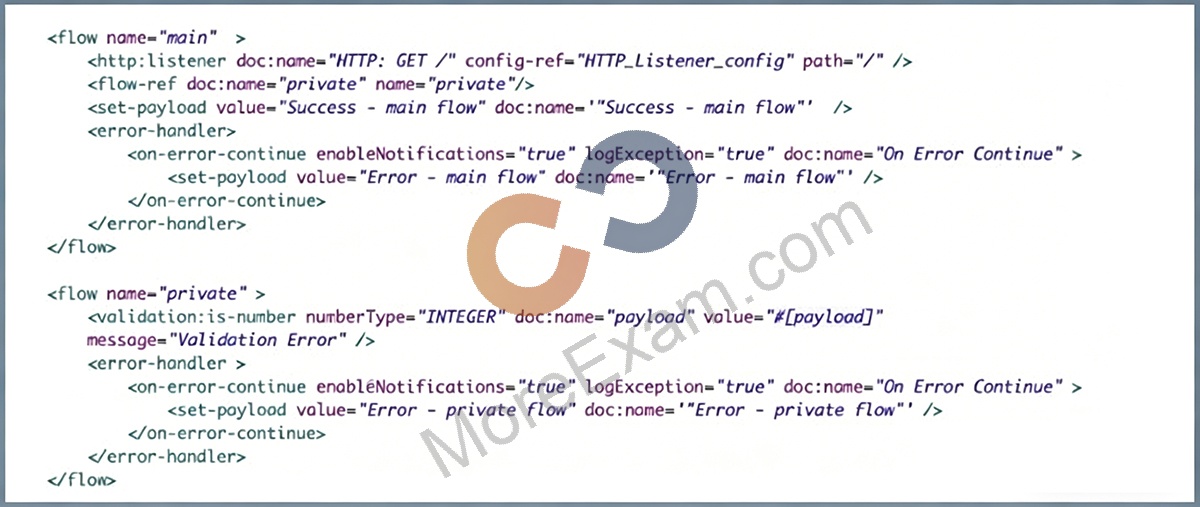
Question146: Refer to the exhibits.


The Validation component in the private flow throws an error. What response message is returned to a client request to the main flow's HTTP Listener?

Question147: Refer to the exhibits.

What payload and quantity are togged at the end of the main flow?

Question148: A Utility.dwl file is located in a Mule project at src/main/resources/modules. The Utility.dwl hie defines a function named pascalize that reformats strings to pascal case.
What is the correct DataWeave to call the pascalize function in a Transform Message component?
A)

B)

C)

D)

Question149: Refer to the exhibits.

What is valid text to set the field in the Database connector configuration to the username value specified in the config.yaml file?

Question150: A web client submits a request to http://localhost:8081?accountType=personal. The query parameter is captured using a Set Variable transformer to a variable named accountType.
What is the correct DataWeave expression to log accountType?

Question151: Refer to the exhibits.

The input array of strings is processed by the batch job that processes, filters, and aggregates the values. What is the last message logged by the Logger component after the batch job completes processing?

Question152: Refer to the exhibit.

What can be added to the flow to persist data across different flow executions?

Question153: Where would you create SLA Tiers for an API?

Question154: Refer to the exhibit.

What should be changed to fix the 415 error?
Question155: Refer to the exhibits.
A web client sends a GET request to the HTTP Listener.
What response message is returned to the web client?

Question156: An app team is developing a mobile banking app. It took them two months to create their own APIs to access transaction information from a central database. The app team later found out that another team had already built an API that accesses the transaction information they need.
According to MuleSoft, what organization structure could have saved the app team two months of development time?

Question157: What are the latest specification of RAML available?

Question158: Refer to the exhibits.


A
web client submits a request to http://localhQst:8081 /flights. What is the result at the end of the flow?

Question159: How are query parameters dynamically passed to an outbound REST request using an HTTP Request operation?

Question160: Refer to the exhibit.
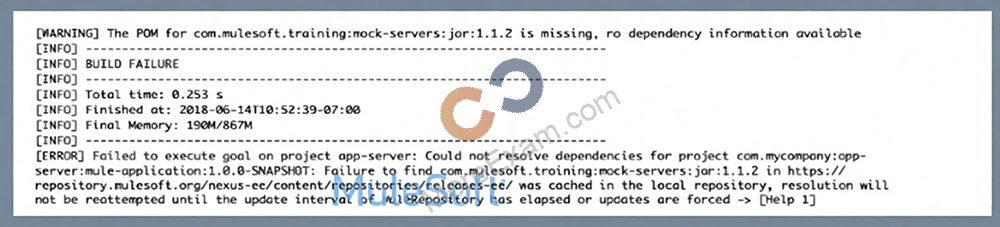
The error occurs when a project is run in Anypoint Studio. The project, which has a dependency that is not in the MuleSoft Maven repository, was created and successfully run on a different computer.
What is the next step to fix the error to get the project to run successfully?

Question161: Refer to the exhibits.


A web client sends a POST request to the HTTP Listener with the payload "Hello-". What response is returned to the web client?
What response is returned to the web client?

Question162: Refer
to the exhibits. A web client submits a request to http://localhost:8081/fliqhts?destination=SFO and the Web Service Consumer throws a WSC:BAD_REQUEST error.
What is the next step to fix this error?

Question163: Refer to the exhibits.


The Batch job processes an array of strings.
What information is logged by the logger component after the batch job scope completes processing of the input payload?

Question164: Refer to the exhibit.

What DataWeave expression transforms the conductorlds array to the XML output?
A)

B)

C)

D)